Introduction
Picture this: a patient lies in a multi-bed emergency bay, separated from the next bed by a fabric curtain. A physician approaches to discuss their diagnosis — lab results, treatment options, a difficult prognosis. The curtain sags slightly at one end. Voices carry. The patient can hear the conversation from the next bay. So can their neighbor.
This isn't a rare scenario. It plays out thousands of times daily across hospitals, urgent care centers, and outpatient clinics throughout the country.
Traditional exam room curtains have served as the default privacy solution for decades. Research on curtain contamination, published in journals including the American Journal of Infection Control, along with rising maintenance costs and patient dignity concerns, is pushing facilities to reconsider that default and evaluate modern medical privacy screens as a practical alternative.
What follows covers the contamination data, how privacy screens work, the compliance implications, and what to prioritize when comparing your options.
Key Takeaways
- Hospital curtains become contaminated with MRSA and VRE within days of installation — fabric cannot be spot-disinfected
- Privacy screens with non-porous, wipeable surfaces can be disinfected between every patient encounter
- Both retractable and portable screens support HIPAA physical safeguard expectations in shared care environments
- Screens eliminate recurring laundering costs and reduce labor time spent on curtain removal and rehang cycles
- USA-manufactured screens deliver faster lead times, stronger quality control, and reliable domestic support
The Hidden Problem with Traditional Exam Room Curtains
Fabric curtains are touched constantly — by nurses pulling them open during rounds, by patients reaching for call buttons, by visitors finding their way around a multi-bed bay. Each contact is an opportunity for pathogen transfer.
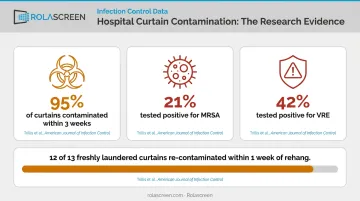
Research published in Infection Control & Hospital Epidemiology found that 41 out of 43 hospital curtains (95%) were contaminated at least once during a three-week observation period — with 21% testing positive for MRSA and 42% for VRE. 12 of 13 freshly laundered curtains became contaminated within one week of being rehung. A separate 2018 study in AJIC tracking curtains in a burns and plastics unit found MRSA present on 1 of 8 test curtains by day 10, and on 5 of 8 by day 14.
The Laundering Problem
The obvious response is to launder curtains more frequently. In practice, this creates its own set of problems:
- Curtains must be physically removed, transported, laundered, and rehung — pulling housekeeping and clinical staff away from patient care
- One published US military facility study documented 105 curtain changes over 20 weeks at a single facility, with staff costs of $485.63 and laundering costs of $379.05 for that period alone
- Even with regular laundering, curtains re-contaminate within days of installation, meaning no practical laundering schedule can keep pace with actual contamination rates
What Makes Curtains Hard to Control
Beyond laundering logistics, curtains present a structural cleanability problem:
- Fabric surfaces cannot be wiped down with hospital-grade disinfectants between patients — the material absorbs rather than resists chemical agents
- Curtains sag, bunch, and deteriorate over time, reducing both physical coverage and professional appearance
- The CDC identifies curtain edges as high-touch housekeeping surfaces requiring risk-based cleaning frequency — but laundering in place is not an option
The result is a surface that cannot be disinfected without full removal — yet re-contaminates within days of being rehung. For facilities under Joint Commission scrutiny or building an infection control compliance record, that cycle is a documented liability, not just an operational inconvenience.
What Are Medical Privacy Screens? Types and How They Work
Medical privacy screens are panels — either freestanding or wall-mounted — designed to create visual separation between patients, treatment areas, or consultation zones. Today's screens use non-porous hard surfaces, roller mechanisms, and hospital-grade materials — a significant departure from the fabric curtains and folding panels most facilities still rely on.
Retractable Privacy Screens
Retractable screens mount directly to a wall and extend outward on a roller mechanism, similar to a large window shade pulled sideways. When not in use, the screen rolls back completely into its housing — freeing floor space and reducing unnecessary surface exposure between patient encounters.
Rolascreen's wall-mounted models, for example, extend up to 123 inches (10'3") wide and are available in standard heights of 5'3" and 6'3", with custom heights available for specific facility requirements. The screen can flex at any point along its width, allowing wraparound coverage of a patient area without requiring multiple separate units.
This makes retractable screens well-suited for fixed exam bays, dialysis stations, infusion centers, and recovery rooms — spaces where the screen position is predictable and wall mounting is practical.
Portable Privacy Screens
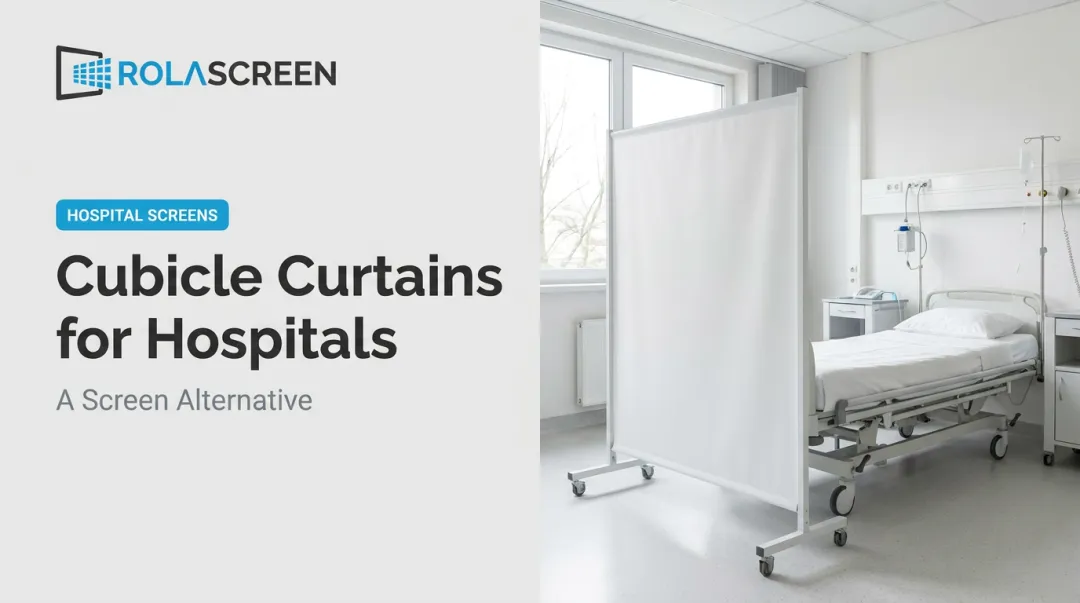
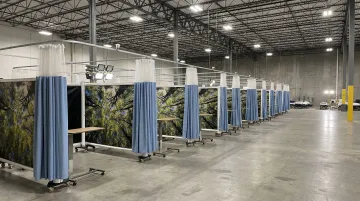
Portable screens are freestanding units mounted on lockable wheels. They roll into position without tools, lock in place via foot-activated casters, and retract into a slim footprint — as narrow as 9 inches — when not in use.
Flexibility is what sets them apart. Emergency departments, disaster shelters, vaccination clinics, and temporary triage areas all benefit from privacy solutions that can be repositioned in seconds. Rolascreen delivered 50 portable units to the Florida Department of Health within four weeks specifically for use in disaster shelter networks — a deployment scenario that fixed curtain tracks simply cannot accommodate.
How Both Types Compare to Curtains
| Feature | Fabric Curtains | Privacy Screens |
|---|---|---|
| Disinfection method | Removal + laundering | Wipe-down in seconds |
| Contamination timeline | Within 1 week of installation | Non-porous surface resists absorption |
| Reconfiguration | Requires new track or fixture | Repositioned in seconds (portable) |
| Durability | Sags, deteriorates over time | Hard-surface construction |
| Surface compatibility | Cannot use hospital disinfectants in place | Compatible with bleach, quats, accelerated H₂O₂ |
Key Benefits of Upgrading to Privacy Screens in Healthcare Settings
Patient Dignity and Trust
Visual privacy has a direct effect on patient behavior and outcomes. A study published in BMC Pregnancy and Childbirth found that after a maternity emergency unit replaced curtained bays with walled cubicles, patients rating their privacy as adequate jumped from 21% to 89%. Patients overhearing their own medical conversations dropped from 49% to 11%.
Patients who feel exposed are less likely to disclose sensitive health information. That directly affects care quality — not just satisfaction scores.
Infection Control Advantage
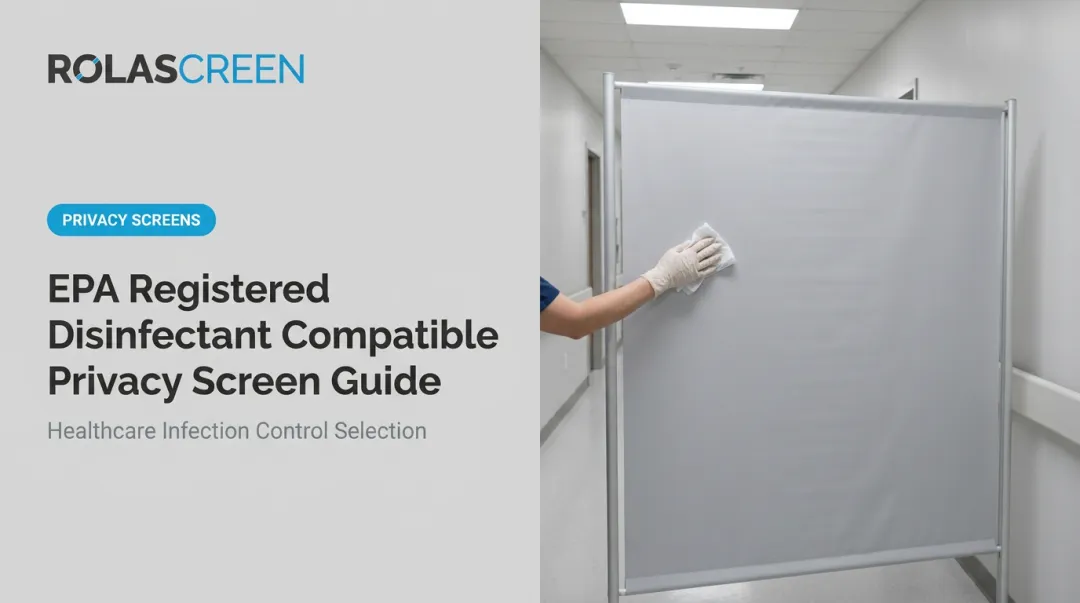
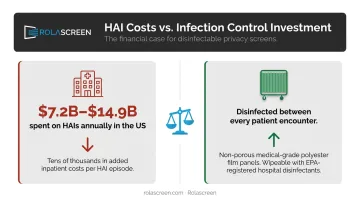
Non-porous screen surfaces can be wiped down with EPA-registered disinfectants between every patient encounter. Fabric curtains, by contrast, must be removed entirely for any meaningful disinfection — a process that takes time, labor, and laundry infrastructure.
The financial stakes of hospital-acquired infections (HAIs) make this more than an operational preference. A 2022 national study estimated that US facilities spent between $7.2 billion and $14.9 billion on HAIs in 2016, with mean additional inpatient costs for individual infection types running into the tens of thousands per episode.
Any surface that demonstrably reduces pathogen transmission between patients carries measurable financial value alongside its clinical benefit.
Todd Axberg, RN, Chief Lead Nurse at Santa Rosa Memorial Hospital's Emergency Department, put it plainly after switching to Rolascreen: "The screens move quickly into place and are extremely easy to clean. They're nothing like the flimsy curtains and screens we used in the past."
Space Flexibility
Unlike fixed curtain tracks, privacy screens — particularly portable models — let facilities reconfigure spaces quickly:
- Convert a waiting area into a vaccination station in minutes
- Add temporary triage capacity during ED surge events
- Create privacy zones in cafeterias, gymnasiums, or conference rooms without construction
- Reposition between shifts based on patient volume and acuity
Customization and Branding
Modern privacy screens aren't purely functional. Rolascreen offers fully customizable printed panels — logos, calming photography, wayfinding information, branded color schemes — so each screen serves as both a privacy barrier and a design element. For pediatric wards, behavioral health spaces, and outpatient clinics where environment directly affects patient comfort, that dual function matters.
Long-Term Cost Efficiency
The upfront cost of privacy screens is higher than purchasing curtains. Over time, the math shifts. Curtains require:
- Regular laundering cycles with associated labor and linen costs
- Replacement inventory as panels deteriorate
- Staff time for removal, transport, and rehang
Screens require periodic wiping — something housekeeping staff already do for every other surface in the room. For high-turnover environments like EDs and urgent care centers, those avoided laundering cycles translate into real operational savings over months and years.
HIPAA Compliance and Infection Control Standards for Exam Room Privacy
What HIPAA Actually Requires
HIPAA does not mandate private rooms or soundproofed walls. HHS guidance is explicit: covered entities are expected to apply reasonable safeguards to limit incidental disclosures of protected health information. In shared care areas, that can mean "cubicles, dividers, shields, curtains, or similar barriers."
Privacy screens satisfy this standard — and arguably more reliably than curtains, which deteriorate and provide inconsistent coverage.
What TJC and CMS Expect
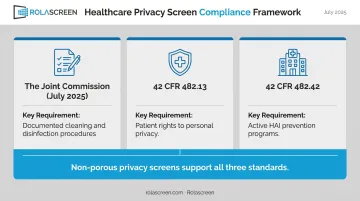
Three regulatory frameworks shape how healthcare facilities approach privacy and infection control:
- The Joint Commission (effective July 2025): Requires documented procedures for cleaning and disinfection of patient-care spaces, surfaces, and equipment
- 42 CFR 482.13: CMS regulations protecting patient rights to personal privacy
- 42 CFR 482.42: Requires active, hospital-wide HAI prevention and control programs
Non-porous screen surfaces support all three requirements directly. Infection control teams can document every wipe-down against a defined disinfectant protocol — something fabric curtains on an infrequent laundering schedule cannot offer.
For open ED bays, vaccination stations, and infusion centers, that means one solution addresses both HIPAA physical safeguard expectations and HAI prevention documentation at once.
What to Look for When Choosing Exam Room Privacy Screens
Material and Cleanability
Material choice directly affects infection control outcomes — and your cleaning protocols:
- Non-porous surface material — resists moisture and does not absorb pathogens
- Compatibility with EPA-registered hospital disinfectants — confirm the product can withstand bleach solutions, quaternary ammonium compounds, and accelerated hydrogen peroxide without degrading
- Avoid fabric-covered panels in any patient care area — they share the same cleanability limitations as traditional curtains
Rolascreen's inner panels use thermally-stabilized medical-grade polyester film specifically chosen for wipeable, non-porous performance with hospital-grade disinfectants.
Size, Coverage, and Configuration
For true visual privacy, prioritize:
- Floor-to-near-ceiling height — standard options of 5'3" and 6'3", with custom heights available
- Wraparound capability — Rolascreen's retractable screens flex at any point along their width, allowing a single unit to wrap around a patient area rather than requiring multiple panels
- Maximum extension width — Rolascreen units extend to 123 inches (10'3"), covering most exam bay configurations without additional units
Durability, Warranty, and Where It's Made
For healthcare procurement, domestic manufacturing matters in ways that go beyond preference:
- US-made screens offer better quality control, faster replacement parts, and domestic customer support
- During high-demand periods — pandemic surges, public health emergencies, natural disasters — domestic manufacturers can fulfill urgent orders that foreign suppliers cannot reliably deliver on
- Rolascreen is the only American manufacturer of retractable medical privacy screens, manufacturing in Chatsworth, California, with Buy America Act alignment for federal and VA procurement
Over 2,000 screens have shipped across 47 states with zero units damaged in transit. Standard lead times run 10–30 days for non-printed units, with expedited options available for urgent facility needs.
Frequently Asked Questions
Are privacy screens more hygienic than exam room curtains?
Non-porous privacy screen surfaces can be wiped down with hospital-grade disinfectants between every patient encounter — taking seconds rather than requiring full removal and laundering. Fabric curtains harbor pathogens and cannot be spot-disinfected, making screens the stronger choice for infection control in active patient care areas.
Do exam room privacy screens need to meet HIPAA requirements?
HIPAA requires covered entities to implement reasonable safeguards for patient privacy. Privacy screens satisfy this by preventing visual exposure of patients and protected health information in shared or open-bay care environments — a recognized physical safeguard for settings where simultaneous patient care occurs.
How often do exam room curtains need to be replaced or laundered?
Research shows contamination occurs within days of installation. One peer-reviewed study found 92% of newly placed curtains were contaminated within a week. Most facilities lack the resources to launder curtains frequently enough to keep pace with that contamination rate.
What materials are used in medical-grade privacy screens?
Medical-grade screens typically use non-porous coated fabrics or hard panel materials that resist moisture and withstand repeated disinfection without degrading. Rolascreen uses thermally-stabilized medical-grade polyester film compatible with bleach, quaternary ammonium, and accelerated hydrogen peroxide disinfectants.
Can privacy screens be customized for different healthcare settings?
Yes. Modern screens can be printed with custom imagery, facility branding, logos, or calming artwork — making them practical for pediatric wards, behavioral health rooms, physical therapy spaces, and outpatient clinics where environment directly affects patient experience and comfort.
How do retractable privacy screens differ from portable room dividers?
Retractable screens mount to a wall and extend or retract as needed — ideal for fixed exam bays, dialysis stations, or recovery rooms with predictable layouts. Portable dividers are freestanding on lockable wheels, repositionable without tools — better suited for emergency surge areas, vaccination stations, or any space requiring frequent reconfiguration.