Introduction
The CPSC documented over 420,000 emergency department-treated injuries from architectural glazing materials between 1991 and 2013, with 96% of reviewed cases involving lacerations. Those figures predate modern safety glazing standards, so non-compliant installations today still pose genuine injury risk — not just a compliance concern.
Glass partitions in commercial, healthcare, and education facilities fall under specific safety glazing requirements in the International Building Code (IBC). Non-compliance can result in failed inspections, liability exposure, and, in serious cases, occupant injury from glass breakage or fall-through incidents.
That's why this guide gives facility managers, architects, and healthcare administrators a clear reference for IBC Section 2406 requirements, material options, installation hazards, and the maintenance considerations that keep glass partitions safe after installation.
Key Takeaways
- Safety glazing ≠ tempered glass — it's any glazing meeting IBC Section 2406 performance standards (ANSI Z97.1 or CPSC 16 CFR 1201)
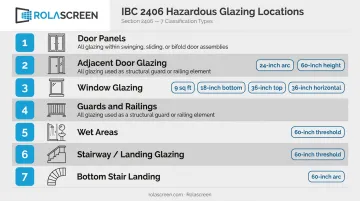
- The IBC defines 7 specific hazardous locations where safety glazing is mandatory
- All compliant safety glazing must carry a permanent manufacturer label — unlabeled glass fails inspection regardless of actual performance
- Installation errors — wrong dimensions, inadequate anchoring — are the most common compliance failures
- Non-glass partitions serve healthcare and education privacy needs without triggering IBC 2406 requirements
IBC Building Code Requirements for Glass Partitions
IBC Section 2406 governs safety glazing in "hazardous locations." The key point: the code focuses on where glass is installed relative to occupant movement — not the glass's appearance, finish, or opacity.
The IBC doesn't mandate tempered glass or any specific manufacturing method — it sets performance requirements. To qualify, glazing must meet:
- Test standard: CPSC 16 CFR Part 1201 or ANSI Z97.1
- Labeling: A permanent identifying label is required on every pane
- Trigger: One of seven hazardous location classifications must apply
Those seven classifications determine whether safety glazing is required at all — and they're detailed below.
Glazing in and Adjacent to Doors
IBC 2406.4.1 classifies all glazing within swinging, sliding, and bifold door panels as hazardous locations — automatically. Exceptions exist for small openings (where a 3-inch sphere cannot pass through), decorative glazing in specific circumstances, and commercial refrigeration cabinets.
IBC 2406.4.2 extends this to adjacent glazing: any panel within a 24-inch horizontal arc of either vertical door edge (in closed position), where the bottom edge sits less than 60 inches above the walking surface, is also a hazardous location. An exception applies where a wall, rather than open space, separates the door from the glazing.
Glazing in Windows, Guards, and Wet Areas
IBC 2406.4.3 — the window threshold — triggers when all four conditions apply simultaneously:
- Exposed pane area greater than 9 square feet
- Bottom edge less than 18 inches above the floor
- Top edge greater than 36 inches above the floor
- Walking surface within 36 inches horizontally
IBC 2406.4.4 covers guards and railings: all glazing in guards, structural baluster panels, and non-structural in-fill panels is classified as hazardous without exception.
IBC 2406.4.5 addresses wet areas — walls, enclosures, or fences adjacent to hot tubs, whirlpools, saunas, steam rooms, bathtubs, showers, and pools. The threshold: bottom edge less than 60 inches above the walking surface.
Glazing Near Stairways and Landings
Two code sections govern stair-adjacent glazing:
- IBC 2406.4.6: Glazing adjacent to stairways, landings between flights, and ramps is hazardous where the bottom edge is less than 60 inches above the adjacent walking surface
- IBC 2406.4.7: Glazing at the bottom stair landing is hazardous where the bottom edge is less than 60 inches above the landing and the glazing falls within a 60-inch horizontal arc from the bottom tread nosing
Safety Glazing Standards and Material Options
The Two Primary Standards
All safety glazing used in IBC-regulated hazardous locations must comply with one of two performance standards.
CPSC 16 CFR Part 1201 is the mandatory U.S. federal consumer product safety standard. IBC Section 2406.2 references two impact categories:
- Category II (400 foot-pound impact test) — the default compliance path for most hazardous locations
- Category I (150 foot-pound impact test) — applies in limited, lower-risk applications
ANSI Z97.1-2015 (R2020) covers impact performance, fragmentation behavior, and weathering. The IBC permits Class A for some non-door, non-wet-area hazardous locations. Key specifications:
- Class A — 48-inch drop height; Class B — 18-inch drop height
- Weathering: one year of natural South Florida exposure or 3,000 hours of accelerated Xenon-Arc testing
Both standards require permanent labeling. The ANSI mark must include supplier name, standard designation (ANSI Z97.1-2015), size classification (L or U), and impact class (A or B).
Comparing the Three Main Material Options
| Material | Breakage Behavior | Best For |
|---|---|---|
| Tempered glass | Shatters into small blunt fragments | General commercial applications, doors |
| Laminated glass | Shards remain bonded to interlayer after breakage | Overhead glazing, guards, fall-through risk situations |
| Polycarbonate | Resists penetration; doesn't shatter like glass | Healthcare, behavioral health, high-security environments |
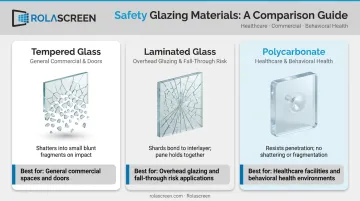
The NYS Office of Mental Health identifies polycarbonate as generally providing the best protection against elopement, jumping, laceration, and weaponization risks in psychiatric environments — a strong endorsement for that specific application context.
Applied Safety Glazing Film
In retrofit situations, safety glazing film applied to existing glass can meet code requirements in some jurisdictions. An ICC-ES evaluation report has confirmed that certain organic-coated safety glazing systems comply with CPSC 16 CFR Part 1201 as required by IBC Section 2406. These films require manufacturer-approved installers, special inspection, and proper labeling. Confirm acceptance with your AHJ (Authority Having Jurisdiction) before specifying film products — approval varies by jurisdiction.
Safety Precautions for Installing Glass Partitions
Before the Glass Arrives
Installation failures often start before the panels are delivered. Address these before ordering:
- Structural adequacy: confirm all floor, wall, and ceiling anchoring points can handle the load — undersized anchors and misaligned tracks are a leading cause of panel instability
- Site dimensions: measure precisely before ordering, since tempered glass cannot be modified after production and incorrect measurements require full panel replacement
- Substrate condition: moisture damage or instability disqualifies a site for installation until the underlying issue is remediated
Safe Handling and Lifting
Large glass panels require at least two trained installers equipped with suction lifters and padded supports. Never rest a glass panel against a surface at a shallow angle, as this raises shatter risk considerably during setup.
When to Stop and Not Proceed
Installation should not move forward if:
- Structural anchoring points are inadequate or unverified
- There is visible moisture damage or substrate instability
- Panel dimensions were measured incorrectly and glass has already been cut to those dimensions
An Alternative Worth Considering
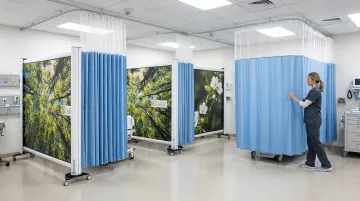
For healthcare and clinical settings where frequent space reconfiguration is the norm, non-glass partition systems eliminate these installation-phase risks entirely. Rolascreen's Portable Elite and Wall-Mounted Elite privacy screens, manufactured in Chatsworth, California, deploy without structural permits or permanent installation requirements.
Portable units roll into position and lock with foot-activated wheel brakes. Wall-mounted units extend up to 18 inches from the wall and are engineered for thousands of extension and retraction cycles. Neither configuration requires a contractor or a construction permit, which matters when reconfiguration needs arise monthly or seasonally.
Common Safety and Code Compliance Mistakes to Avoid
Skipping the Permanent Label Check
Installers and facility managers frequently assume purchased glass meets safety glazing requirements. Unlabeled glass — or glass from which the label has been removed — will fail inspection regardless of actual performance.
The IBC requires permanent designation using one of these approved methods:
- Acid etching
- Sandblasting
- Ceramic firing
- Laser etching
- Embossing
Film-applied labels may be rejected by some AHJs. Check that labels are intact before installation, not after.
Misapplying the "Decorative Glazing" Exception
The IBC provides narrow exceptions for decorative glass in certain hazardous locations, but these are frequently misread as blanket exemptions. Decorative glass only avoids safety glazing requirements when it falls within a specific named exception — it does not automatically qualify as safe in any hazardous location. If the exception doesn't clearly apply, treat the location as hazardous and specify compliant glazing.
Assuming Local Code Matches the IBC
The IBC is a model code adopted across all 50 states, but many jurisdictions adopt amended versions with stricter or different requirements. Three documented examples:
- California: OSHPD hospital and DSA school occupancies require submitted construction documents and analysis for glass supports, plus minimum glass edge clearances of at least 3/16 inch where glass height exceeds 3 feet
- Florida: High-Velocity Hurricane Zone provisions require exterior glazing to resist large missile impact within the lowest 30 feet
- New York City: The 2022 NYCBC requires laminated glass for elevator hoistway enclosures, elevator doors, and car interior linings, and mandates tempered glass for fire department access panels
Always verify your jurisdiction's adopted edition and any local amendments before finalizing specifications — AHJ requirements can diverge significantly from the base IBC.
Frequently Asked Questions
What are the IBC requirements for safety glass?
IBC Section 2406 requires safety glazing in seven defined hazardous locations. Qualifying glazing must be tested to ANSI Z97.1 or CPSC 16 CFR Part 1201 and carry a permanent manufacturer label identifying the standard and testing category. The default impact performance path is CPSC 16 CFR Part 1201 Category II (400 foot-pounds).
Where does the building code require safety glass and at what heights?
Key thresholds: glazing adjacent to doors must have its bottom edge within 60 inches of the floor; window glazing triggers the requirement when the bottom edge is below 18 inches; stairway and landing glazing must have its bottom edge below 60 inches above the walking surface; bottom-landing glazing must also fall within a 60-inch horizontal arc from the bottom tread nosing.
How do building codes regulate the use of glazing, and why?
Codes regulate glass through location-based hazard classifications — not by material appearance. Areas where occupants are more likely to impact glass (near doors, on stairways, in wet areas) require performance-tested glazing. The goal is reducing laceration and fall-through injuries, which account for the vast majority of architectural glazing incidents.
What is the difference between tempered glass and safety glass?
"Safety glazing" is the broader code category — any tested, permanently labeled glazing that meets ANSI Z97.1 or CPSC 16 CFR Part 1201 impact standards. Tempered glass is one type; laminated glass and polycarbonate are others. Not all tempered glass carries the proper safety glazing certification, and not all safety glazing is tempered.
Do interior glass partitions in offices or healthcare facilities need to meet safety glazing requirements?
Yes, if they fall within any of the seven hazardous location classifications — particularly near doors or within the walking surface clearances defined in IBC 2406.4.2 and 2406.4.3. Interior location does not exempt a partition from the code.
What labeling is required on safety glazing products?
Safety glazing must carry a permanent label (acid etched, sandblasted, or ceramic fired) identifying the manufacturer, the applicable standard (ANSI Z97.1 or CPSC 16 CFR 1201), and the testing category. For organic-coated glass tested from one side only, CPSC regulations also require the label to read GLAZE THIS SIDE IN. Film-applied labels may be rejected by some AHJs during inspection.