Introduction
Facilities today face a genuine operational tension: create open, welcoming environments while meeting increasingly strict safety, hygiene, and building code requirements. In healthcare, education, and commercial settings, that tension plays out daily across every reception counter, corridor, and open-plan workspace.
Clear safety partitions have emerged as a practical answer — and not merely because they look good. Facility managers and healthcare administrators track concrete outcomes: infection control, code compliance, occupant safety, and space efficiency. A well-chosen partition delivers on all four.
This article examines the operational advantages of clear safety partitions, where they deliver the most impact, and what facilities risk when they choose cheaper alternatives that create larger compliance and infection-control problems down the line.
Key Takeaways
- Glass safety partitions use tempered or laminated glass engineered to resist impact and break safely—not standard construction glass
- Their non-porous surfaces are compatible with hospital-grade disinfectants, making them a frontline infection control asset
- CPSC data estimates 73,000 annual injuries annually from architectural glazing failures before safety standards took effect
- Compliance-grade glass partitions meet IBC Chapter 24 hazardous location requirements and hold up under infection control audits
- Fixed glass installations pair well with retractable privacy screens in facilities that need on-demand spatial reconfiguration
What Are Glass Safety Partitions?
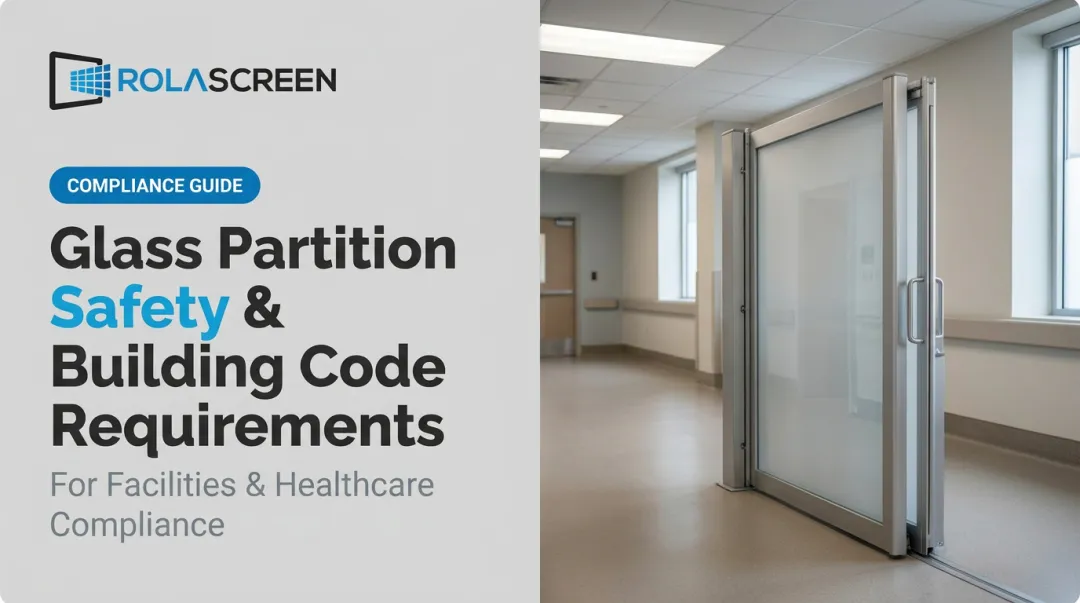
Glass safety partitions are interior or counter-mounted dividers made from engineered safety glass—either tempered or laminated—used to physically separate spaces, protect occupants, or manage traffic flow in commercial and institutional environments.
Unlike standard decorative dividers, these are load-bearing, code-governed building components.
Where They're Deployed
Common applications include:
- Hospital reception areas and pharmacy counters
- Emergency department triage zones
- School corridors and administrative windows
- Open-plan offices and collaboration areas
- Government service desks and airport checkpoints
- Retail customer-facing counters
What Makes Them "Safety" Glass
The distinction from standard glass matters. Under ANSI Z97.1 and CPSC 16 CFR Part 1201, safety glazing materials are specifically constructed or treated so that when broken by human contact, the risk of cutting or piercing injuries is reduced. This is a regulatory requirement — not a product descriptor.
Two primary types meet this standard:
- Tempered glass is heat-treated to be significantly stronger than annealed glass; when it breaks, it crumbles into small blunt-edged pebbles
- Laminated glass bonds multiple glass layers to a resilient plastic interlayer, keeping broken pieces in place rather than scattering
Both are compliance-grade materials. Neither is interchangeable with standard construction glass in locations designated as hazardous under IBC Section 2406. Understanding these compliance requirements is the foundation for evaluating where glass partitions fit — and where alternative partition systems may serve the same safety goals more flexibly.
Key Advantages of Glass Safety Partitions
Each advantage below maps to outcomes facility managers, healthcare administrators, and space designers actively measure.
Advantage 1: Impact Resistance and Structural Safety
Tempered glass isn't just stronger than standard glass—according to the National Glass Association, fully tempered glass has approximately 4x the breakage strength of annealed glass of the same thickness. Heat-strengthened glass delivers roughly 2x. That gap matters considerably when the partition sits in a pediatric ward, a school hallway, or an emergency department where equipment carts, wheelchairs, and people collide with surfaces constantly.
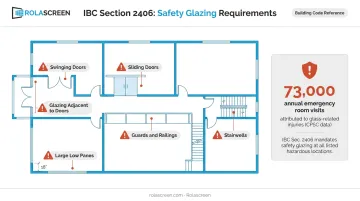
The injury data reinforces why this matters. Before federal safety standards for architectural glazing were enacted, CPSC estimated 73,000 annual injuries related to architectural glazing materials—with lacerations as the most common injury type and children under 15 accounting for a disproportionate share.
What this means operationally:
- Non-safety glass in hazardous locations creates direct injury liability exposure
- IBC Section 2406 mandates safety glazing in specific interior locations—swinging and sliding doors, glazing adjacent to doors, large low panes, guards, and railings
- Facilities using standard glass where code requires safety glazing face compliance failures, potential fines, and costly retrofits
KPIs this affects: Injury incident rates, insurance and liability exposure, and code compliance pass rates during inspections.
The highest-stakes settings are predictable: pediatric wards, school environments, emergency departments, and any area with regular heavy equipment traffic. For these facilities, the performance difference between standard and safety glass isn't theoretical — it shows up in incident logs and inspection results.
Advantage 2: Hygiene and Infection Control
Glass is non-porous. That single material property separates it from every fabric curtain, soft partition, and many plastic barriers used in clinical environments — and it has direct implications for infection control.
The problem glass partitions address is well-documented. The CDC reports that on any given day, about 1 in 31 U.S. hospital patients has at least one healthcare-associated infection (HAI), with AHRQ estimating more than 1 million HAIs annually across the U.S. healthcare system — adding billions to care costs.
Environmental surfaces, including partitions, dividers, and barriers, play a documented role in transmission.
CDC infection control guidance consistently emphasizes surfaces that are cleanable, durable, smooth, nonabsorptive, and nonporous in clinical areas. Glass meets all five criteria.
Day-to-day impact:
- Staff can disinfect glass partitions thoroughly between patient interactions using hospital-grade disinfectants, without surface degradation
- No biofilm accumulation in surface pores—a persistent problem with fabric alternatives
- Cleaning can be done in a single wipe-down pass during standard rounds
Compare that to porous alternatives. Repeated disinfectant exposure can degrade acrylic and polycarbonate plastics—research documents measurable increases in surface roughness and discoloration under disinfection protocols, which compromises cleanability and creates new contamination risks over time.
Infection control performance matters most in hospitals, clinics, rehabilitation centers, and VA facilities serving immunocompromised patients — anywhere surface contamination rates appear on audit reports. The surface material choice is a direct input to those numbers.
Advantage 3: Aesthetic Openness and Space Efficiency
Beyond hygiene and safety, there's a spatial dimension that affects both staff performance and patient outcomes. Opaque walls and fabric dividers divide space — but they also cut off light, fragment sight lines, and make large facilities feel more closed-off than they need to be.
Glass partitions separate spaces without closing them off. The evidence for why this matters goes beyond preference.
The research base on daylight and views is substantial:
- A 2019 Building and Environment study found daylight access improved working memory, satisfaction, and reduced eyestrain
- Ulrich's 1984 research showed surgical patients with natural views had shorter postoperative stays and required fewer analgesics
- A cardiac ICU study of 2,319 patients linked daylight and window access to shorter stays among mechanically ventilated patients
Operational effects of glass partitions:
- Healthcare staff maintain visual supervision across open areas without physical barriers blocking sight lines
- Office teams preserve a sense of connection while still having defined spatial separation
- Service counters stay approachable rather than fortress-like—important for patient trust and customer experience
- Facilities avoid costly drywall construction when reconfiguring spaces
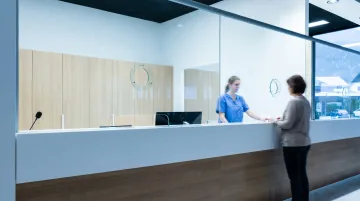
Design note on visual privacy: Frosted or filmed glass is a practical option for areas where reasonable visual privacy is warranted. HHS has clarified that HIPAA does not require private or soundproof rooms—covered entities must use reasonable safeguards. Frosted glass is a design choice that supports that goal, not a mandated requirement.
What Happens When Glass Safety Partitions Are Overlooked
The pattern is consistent across facility types. When managers opt for cheaper alternatives, operational costs accumulate faster than the upfront savings justify.
Plastic barriers and sheeting carry a hidden lifecycle cost. Research documents measurable surface roughness increases in polycarbonate and degradation in acrylic under repeated disinfectant exposure — compromising cleanability in clinical settings where surface integrity is tied directly to infection control. What looked cost-effective at purchase becomes a replacement liability within months.
Fabric curtains present a different problem: independent CFU testing has documented significant microbial colonies on fabric surfaces, a contrast to non-porous alternatives where contamination doesn't accumulate the same way.
Non-safety glass in code-required locations creates a compliance risk that can arise without warning. Delaware law, for example, makes it unlawful to sell, install, or contract to install non-safety glazing in hazardous locations. Similar enforcement exists across jurisdictions. Facilities discovered using standard glass where safety glazing is required face not just fines but potentially costly retrofits on an emergency timeline.
Each of these scenarios — material failure, infection exposure, code violations — represents a cost that compounds when it isn't planned for. Choosing the right partition material upfront avoids reactive spending, unplanned retrofits, and the liability that follows an incident.
How to Get the Most Value from Glass Safety Partitions
Specification decisions determine whether a glass partition performs as intended or creates problems of its own.
Match glass type to environment:
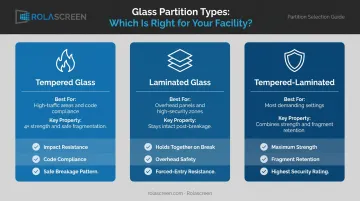
| Glass Type | Best For | Key Property |
|---|---|---|
| Tempered | High-traffic areas, code compliance | 4x strength, safe fragmentation |
| Laminated | Overhead panels, high-security zones | Stays intact post-breakage |
| Tempered-laminated | Most demanding settings | Both strength and fragment retention |
Proper installation determines real-world performance. Correctly specified glass underperforms if mounted without proper support systems, edge protection, or sealing. In healthcare settings, structural gaps around partitions create hygiene risks that defeat the infection control purpose entirely.
Plan for spatial flexibility. Permanent glass works well for fixed barriers at reception counters, corridor separations, and defined zones. But facilities with dynamic space needs—seasonal surge capacity, emergency expansion, rotating room configurations—often find that fixed glass alone doesn't cover every scenario.
Pairing fixed glass with retractable or portable partition systems fills those gaps. Rolascreen's portable and wall-mounted privacy screens are deployed in hospitals, clinics, and government facilities across the country precisely because they complement permanent infrastructure rather than replace it.
The Rolascreen Guard line offers clear partition options for reception and checkpoint applications — a practical complement to fixed glass where counter configurations or patient flow patterns shift.
For facilities specifying integrated solutions, Rolascreen offers consultation, CAD/design support, and installation guidance. Contact their team at 1-800-259-4214 or sales@rolascreen.com.
Conclusion
Glass safety partitions earn their place in facility planning through three simultaneous outcomes: impact safety, infection control, and spatial efficiency. Each maps to metrics that matter — injury incident rates, HAI compliance, staff satisfaction scores, and long-term maintenance costs.
Treat partition specification as an ongoing operational practice, not a one-time decision:
- Match the glass type to the environment and use case
- Prioritize installation quality over upfront cost savings
- Complement permanent glass with flexible systems where rapid reconfiguration matters
That last point is where retractable privacy screens earn their place alongside permanent glass. Where construction isn't feasible — triage bays, open treatment areas, temporary isolation zones — portable and wall-mounted screens like those from Rolascreen close the gap. The result is a facility that doesn't wait for compliance failures or infection events to act on them.
Frequently Asked Questions
How much do glass safety partitions cost?
Installed costs typically range from $30 to $140 per square foot for commercial applications, depending on glass type, thickness, framing system, and labor market. Full projects can run from $1,500 to $18,000 or more. These are budgetary figures—get a project-specific quote from a commercial glazier for accurate numbers.
Are glass safety partitions safe?
Yes. When manufactured from tempered or laminated glass and professionally installed, these partitions are specifically engineered to minimize injury risk. Tempered glass breaks into small blunt fragments; laminated glass holds together on impact. Both meet ANSI Z97.1 and CPSC 16 CFR Part 1201 safety standards.
What types of glass safety partitions are available?
The main types are frameless, framed (aluminum or steel), sliding, fixed counter-mounted, and freestanding partitions. Each suits different spatial and safety requirements across healthcare, commercial, and institutional settings, with varying acoustic performance and installation complexity.
What is a 30-minute fire-rated glass partition?
A 30-minute fire-rated partition is a complete assembly—glass, frame, seals, and hardware—tested under ASTM E119 or UL 263 to contain fire and limit heat transfer for that duration. These assemblies differ from standard safety glass and are required by building codes in locations such as corridors and stairwells.
What is the difference between tempered and laminated glass partitions?
Tempered glass is heat-treated for strength and breaks into small, safe fragments on impact. Laminated glass has a bonded interlayer that keeps broken pieces in place. Both qualify as safety glass under applicable standards, but laminated is the better choice for overhead panels, high-security counters, or anywhere the partition must stay intact after breakage.
Can glass safety partitions be used in healthcare facilities?
Yes—they're widely used in hospitals, clinics, and outpatient facilities. Their non-porous surfaces are compatible with hospital-grade disinfectants and support infection control protocols. They also allow staff to maintain visual supervision across patient areas while maintaining physical separation between zones, which is an important operational consideration in open-plan clinical spaces.