Introduction
Every surface in a healthcare environment is a potential transmission route. According to the CDC, about 1 in 31 U.S. hospital patients has at least one healthcare-associated infection on any given day — and environmental surfaces, including privacy barriers, contribute to that burden through contaminated hands and direct contact.
The room divider choice matters more than many procurement teams realize. A fabric curtain in a shared patient bay isn't just a privacy tool — it's a high-touch surface that accumulates pathogens between every patient interaction. Choosing the wrong barrier undermines cleaning protocols, creates compliance gaps, and increases infection risk.
What follows breaks down the six factors that should drive your decision — starting with surface material and ending with total cost of ownership — so your infection control team and facilities staff are working from the same page.
Key Takeaways
- Fabric hospital curtains harbor MRSA, VRE, and C. difficile — and recontaminate within days of laundering
- Retractable hard-surface screens can be fully disinfected with a single wipe-down using EPA-registered hospital disinfectants
- Six factors drive the right choice: surface material, disinfectant compatibility, portability, coverage, standards compliance, and durability
- Look for non-porous panels, seamless construction, and verified chemical resistance documentation — not all retractable dividers meet this standard
- USA-made retractable screens from a domestic manufacturer ensure faster lead times, Buy America compliance, and direct support
What Is a Retractable Room Divider?
A retractable room divider is a wall-mounted or freestanding screen that deploys and retracts via a rolling mechanism, creating an instant privacy barrier between patients, beds, or treatment zones — without permanent construction or facility modification.
Core Components
Two components determine how cleanable a retractable divider actually is in practice:
- Surface panel — the screen face that gets wiped down between every patient interaction. In healthcare settings, this must be a hard, non-porous material with no stitching, fabric weave, or seams where pathogens can shelter.
- Frame and hardware — the structure surrounding the panel. Recessed hinges and smooth frame profiles reduce crevices where bacteria accumulate — check these surfaces during any procurement evaluation, not just the panel face.
Two Types Used in Healthcare
| Type | Ideal Settings |
|---|---|
| Wall-mounted retractable | Permanent patient bays, ICUs, semi-private rooms, dialysis stations |
| Freestanding portable (wheeled) | Emergency departments, overflow surge bays, COVID triage zones, temporary isolation areas |
The type you choose affects more than logistics — it shapes how consistently staff can clean and reposition the divider under real clinical conditions.
Why Retractable Room Dividers Outperform Traditional Options for Infection Control
The case against fabric curtains isn't theoretical. Research by Ohl et al. found that 41 of 43 hospital privacy curtains (95%) were contaminated at least once, with 21% testing positive for MRSA and 42% for VRE. More telling: 12 of 13 newly hung curtains (92%) were contaminated within a single week of installation.
A separate prospective study by Shek et al. found that freshly laundered curtains became progressively contaminated with bacteria including MRSA, with 87.5% of tested curtains contaminated by day 14.
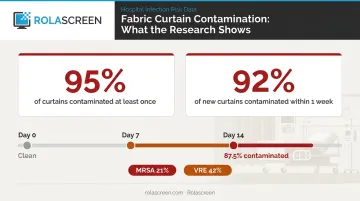
Fabric doesn't just get dirty; it stays dirty. The fiber matrix traps pathogens in spaces where disinfectants can't penetrate, and laundering only resets the clock briefly before recontamination resumes.
Hard-surface alternatives address the laundering problem — but not all of them equally. Folding accordion-style dividers, for instance, introduce their own contamination risks: multiple hinges, overlapping panel edges, and surface joints create debris traps that are difficult to clean consistently. A retractable screen with a continuous, smooth panel surface eliminates most of those mechanical crevices, leaving staff with a wipe-down surface rather than a disassembly problem.
The Cleaning Efficiency Gap
The practical cleaning difference is significant:
- Fabric curtain: Requires removal, laundering, and rehang cycle — taking a zone out of service and incurring labor costs each time. One documented organization changed curtains only every six months unless a contact-precautions patient was discharged
- Hard-surface retractable screen: Wiped down in under two minutes with the same EPA-registered disinfectants used on bedrails and overbed tables — no downtime, no laundering cycle, no zone disruption
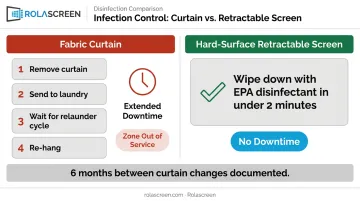
When a new infectious or immunocompromised patient arrives, staff need to reconfigure the space immediately. A retractable screen deploys or retracts in seconds without tools, closing the window during which cross-contamination can occur.
Key Factors to Consider When Choosing a Retractable Room Divider for Infection Control
Infection control requirements vary by facility type, patient population, and acuity level. A factor critical in an ICU may carry different weight in an outpatient clinic. The six factors below help procurement teams connect product specifications to measurable infection control outcomes.
Surface Material and Construction
The screen material determines whether the divider can be reliably decontaminated between patients — and it's the first specification to evaluate.
Look specifically for:
- Non-porous, solid-surface panels — no mesh, no fabric, no perforated materials
- No stitching or seams on the panel face — these create physical refuges for pathogens that disinfectants can't reach
- Hard, smooth surface — functionally analogous to a bedrail or overbed table for EPA-registered disinfectant purposes
Rolascreen's panels use a non-porous thermally-stabilized polyester film — a continuous hard surface with no fiber matrix and no weave structure. There is no wicking effect; fluids stay on the surface where disinfectants can reach them.
Compatibility with Hospital-Grade Disinfectants
Not every hard surface tolerates the full spectrum of healthcare disinfectants. Bleach (sodium hypochlorite), quaternary ammonium compounds, accelerated hydrogen peroxide, and phenolics each have different chemical aggressiveness.
Why this matters operationally: A screen that degrades under bleach develops micro-cracks and surface roughness over time. Those micro-cracks become new sites for bacterial adhesion, directly undermining the infection control rationale for the purchase.
Before procurement, require the manufacturer to provide:
- Chemical resistance documentation for each disinfectant used in your facility
- Confirmation of compatibility with bleach solutions at CDC-recommended concentrations for C. difficile (1,000–5,000 ppm)
- Documentation covering quats, accelerated hydrogen peroxide, and alcohol-based wipes
Rolascreen panels are documented as compatible with sodium hypochlorite up to 10,000 ppm, quaternary ammonium compounds including CaviCide, and accelerated hydrogen peroxide products.
Portability and Deployment Flexibility
Infection control in modern healthcare is dynamic. Outbreak rooms, overflow surge bays, and temporary isolation zones all require barriers that staff can deploy without maintenance teams or tools.
Ask yourself:
- Can one staff member reposition this screen without assistance?
- How long does deployment or retraction take?
- Does it require any assembly or tools?
A screen that requires two staff members to move, or that takes several minutes to configure, increases the likelihood that staff skip reconfiguring spaces between patients. That skipped step is where protocol breaks down.
Rolascreen's Portable Elite weighs 65 lbs for the 6'3" model and moves on smooth-rolling, locking medical-grade casters. It deploys from storage in under a minute and retracts to approximately 9 inches in storage depth.
Coverage Area and Configuration Flexibility
A divider must adequately cover the intended space. Width, height, and the ability to curve around bed configurations determine whether real separation is achieved.
Key specifications to evaluate:
- Maximum extended width — Rolascreen units extend to 123 inches (10'3"), enough to fully span most standard patient bays
- Height options — standard heights of 6'3" and 5'3", with custom heights available
- Bendability — screens that can be shaped into an L-configuration at any point along their width offer far greater flexibility in equipment-dense ICU or ED environments, where a flat panel often can't fully enclose a bed space
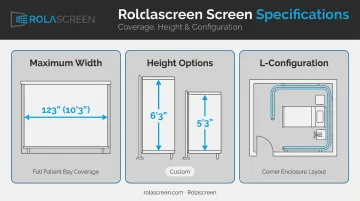
For open-bay environments like dialysis centers or vaccination areas, confirm whether the product supports multi-unit deployment. Rolascreen wall-mounted units can be installed at fixed intervals along a bay wall; portable units can be positioned end-to-end across large open areas.
Compliance with Infection Control Standards
Healthcare facilities operate under multiple overlapping standards:
- The Joint Commission EC.02.06.01 requires interior spaces to meet patient population needs and remain safe and suitable for care — furnishings and barriers are included in this scope
- ICRA (Infection Control Risk Assessment), as defined by ASHE, is a documented process for identifying infection-control precautions during construction and renovation; retractable screens that can be deployed without construction activity help facilities maintain ICRA compliance during phased projects
- HIPAA (45 CFR 164.530(c)) requires appropriate physical safeguards for protected health information; HHS guidance confirms that curtains, screens, or similar barriers may serve as reasonable safeguards in shared spaces
Hospital infection control committees will also evaluate products against internal protocols. Request manufacturer documentation, cleaning validation data, and references from comparable facilities before presenting to your committee.
Durability and Long-Term Value
Purchase price is rarely the right metric in healthcare procurement. Surface degradation, replacement frequency, and labor costs together determine whether a product delivers value over its service life.
Questions to ask manufacturers:
- What is the expected service life under daily disinfection?
- What does surface degradation look like over a 3-year period?
- What warranty is provided, and what does it cover?
The supply chain dimension also matters. Facilities that need to scale quickly during a surge benefit from manufacturers with domestic production and fast turnaround. Rolascreen's USA manufacturing in Chatsworth, California means no international shipping delays, and expedited orders for non-printed screens can be fulfilled in as few as 14 days.
How Rolascreen Can Help
Rolascreen is the only American manufacturer of retractable medical privacy screens. Its Chatsworth, California facility controls material quality, production speed, and product consistency — advantages that matter when a facility needs to respond quickly to an outbreak or surge.
For infection control procurement specifically, here's what sets Rolascreen apart:
- Panel surfaces are non-porous and wipe-clean, compatible with bleach up to 10,000 ppm, quaternary ammonium compounds, and accelerated hydrogen peroxide — validated for the same protocols used on bedrails and overbed tables
- Portable Elite screens bend into an L configuration at any point along their width and hold that angle, so a single unit can enclose complex bed and equipment layouts without improvising with multiple pieces
- Standard lead times run 10–30 days for non-printed screens; expedited production ships in as few as 14 days for qualifying orders
- Rolascreen has supplied over 900 hospitals, clinics, VA facilities, and government health departments across 47 states — including Kaiser Permanente, UPMC, UCLA, UCSF, and NYC Health + Hospitals
- During COVID-19, the company delivered 200+ partitions to VA and military facilities and fulfilled 50 portable units to the Florida Department of Health for disaster shelters within 4 weeks of order
- Panels can be printed with facility branding, patient-calming imagery, or wayfinding without affecting surface disinfectability
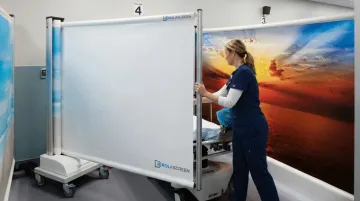
All screens ship with a full warranty and US-based customer support. Across more than 2,000 units delivered, zero have arrived damaged.
Conclusion
The right retractable room divider for infection control isn't the cheapest option or the most visually appealing. It's the one with a non-porous surface, verified disinfectant compatibility, rapid deployment, and documentation that satisfies your infection control committee and standards body.
Infection control protocols evolve and space configurations shift. Choose a retractable divider built for adaptability, not just today's layout. Periodically review screen performance, cleaning compliance, and surface integrity as part of your broader infection prevention program, and apply the same rigor to barrier selection that you do to hand hygiene and PPE protocols.
Frequently Asked Questions
What are the infection control measures in hospitals?
Hospital infection control uses a layered approach: hand hygiene, appropriate PPE, environmental cleaning and disinfection, and transmission-based precautions. Physical barriers like retractable room dividers support this framework by reducing cross-contamination in open patient areas where single-room isolation isn't feasible.
What alternatives exist to hospital curtains?
The main alternatives are retractable hard-surface screens, folding polycarbonate panels, and modular temporary wall systems. Retractable screens offer the strongest combination of cleanability, deployment speed, and infection control performance, particularly compared to folding panels that accumulate debris at hinge points.
What is a Kwick Screen?
KwickScreen (also stylized Kwick Screen) is a brand of retractable hospital privacy screen that originated in the UK, associated with the Royal College of Art in London. Rolascreen began as KwickScreen USA in 2012, distributing the product domestically before rebranding and transitioning to independent USA-based manufacturing in 2019.
Are retractable room dividers compatible with hospital-grade disinfectants?
Medical-grade retractable screens with non-porous hard surfaces are generally compatible with bleach solutions, quaternary ammonium compounds, and accelerated hydrogen peroxide. Always request chemical resistance documentation from the manufacturer for your facility's specific disinfectant protocols before procurement — compatibility varies by product.
How often should retractable room dividers be cleaned in a healthcare setting?
Screens should be wiped down between every patient use, with terminal cleaning when a room or bay is vacated. Hard-surface retractable screens support this cadence: the entire panel disinfects in under two minutes using standard wipe protocols, with no removal or laundering required.
Can retractable room dividers help with HIPAA compliance?
Yes. HIPAA's physical safeguard requirements under 45 CFR 164.530(c) mandate reasonable measures to protect patient privacy, and HHS has confirmed that screens can serve as appropriate safeguards in shared spaces. Retractable screens around exam or treatment areas satisfy these requirements without permanent construction.