That default deserves scrutiny. According to the CDC, approximately 1 in 31 U.S. hospital patients has a healthcare-associated infection (HAI) on any given day. Meanwhile, HAI performance now carries direct financial consequences: CMS reduces total Medicare payments by 1% for hospitals whose Hospital-Acquired Condition score exceeds the 75th percentile. Privacy solutions that double as infection reservoirs aren't just a clinical problem — they're a financial one.
This comparison breaks down what each solution actually offers, where each falls short, and how to decide which belongs in your facility.
Key Takeaways
- Hospital curtains are familiar and code-compliant but are documented reservoirs for MRSA, VRE, and other drug-resistant organisms
- Non-porous, wipeable privacy screens slot into standard disinfection workflows — no removal, no laundering required
- Curtains have lower upfront costs; screens reduce ongoing laundry, replacement, and labor burdens over time
- Screens can be deployed, repositioned, or stored in minutes — curtains are fixed to their track
- The right choice depends on your space type, infection-control standards, and existing ceiling track infrastructure
Hospital Curtains vs. Privacy Screens: Quick Comparison
| Dimension | Hospital Curtains | Privacy Screens |
|---|---|---|
| Upfront Cost | Lower per-unit purchase price | Higher initial investment |
| Installation | Ceiling track required | Freestanding portable (no installation) or wall-mounted |
| Infection Control | Porous fabric; requires laundering; documented MDRO risk | Non-porous surface; wipe-clean with EPA-registered disinfectants |
| Flexibility | Fixed to ceiling track; cannot be repositioned | Move, reconfigure, or store in minutes |
| Maintenance | Regular laundering, scheduled replacement, staff labor | Periodic wipe-down; no removal required |
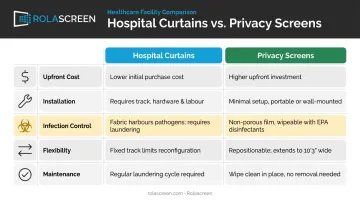
The right choice depends on four factors: your facility type, existing infrastructure, infection-control priorities, and how frequently your layout changes. The sections below break down each dimension in detail.
What Are Hospital Curtains?
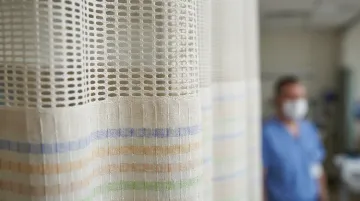
Hospital curtains — also called cubicle curtains or nurse curtains — are fabric dividers suspended from ceiling-mounted tracks. Most are made from inherently flame-retardant (IFR) fabric, with a mesh top section required by NFPA 13 to allow ceiling sprinkler penetration in the event of a fire. Under the 2019 edition (Section 10.2.7.2.2), the mesh must be at least 70% open and extend at least 22 inches down from the ceiling to qualify for the light-hazard obstruction exception.
Operational Benefits
Curtains have been the standard for a reason. Key advantages include:
- Immediate visual privacy across large multi-bed bays
- Low per-unit purchase price and wide availability
- Design flexibility — available in multiple colors, patterns, and antimicrobial fabric options
- Familiar to clinical staff and facilities teams
The Infection-Control Problem
This is where curtains struggle. Fabric is porous, and porous surfaces are difficult to decontaminate through standard wipe disinfection. A 2022 University of Michigan-affiliated study found MDRO contamination on 22% of 1,521 curtain samples across six skilled-nursing facilities — including VRE (13.8%), resistant gram-negative bacteria (6.2%), and MRSA (4.9%).
Contamination happens fast. A 2018 burn and plastics ward study found MRSA on 5 of 8 curtains within 14 days — without any visible soiling. High-risk units cannot rely on scheduled laundering alone to control contamination.
Standard disinfectant spray isn't a fix either. CDC guidance explains that cotton and gauze can absorb quaternary ammonium compounds, reducing their microbicidal action — meaning surface chemistry limits what sprays can accomplish on porous textiles.
Maintenance Realities
Because spray disinfection alone is unreliable on fabric, laundering becomes the primary control measure — and it carries real operational costs. CDC recommends laundering curtains when visibly soiled and on a regular schedule set by environmental services and infection-control staff, though there is no universally mandated change interval. One published military hospital study documented a $3.61 per-panel cost per laundry cycle, with curtains changed every six months under routine conditions and immediately following contact or droplet precaution discharges. In higher-risk areas, effective management may require more frequent cycles.
Over a 3–5 year period, recurring laundry costs, staff labor, and replacement panels can exceed the original purchase price several times over — a total cost of ownership that rarely surfaces in procurement comparisons.
Use Cases for Hospital Curtains
Best suited for:
- Large, permanent multi-bed inpatient wards where ceiling track infrastructure already exists
- Facilities with robust on-site laundry capacity and defined change-out schedules
- Settings where simple visual separation — rather than full infection-zone isolation — is the primary goal
Less suitable for:
- Rapidly reconfigured spaces or surge capacity scenarios
- High-MDRO-risk environments like burn units or transplant floors
- Facilities without the laundry infrastructure to maintain appropriate change frequency
What Are Hospital Privacy Screens?
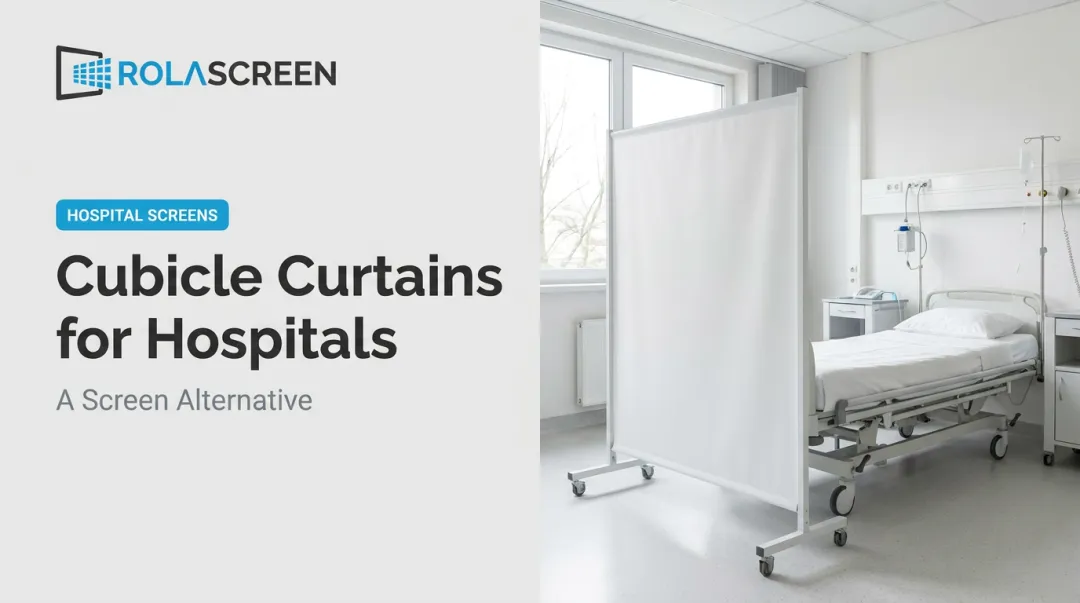
Hospital privacy screens are freestanding or retractable dividers that create visual and partial acoustic separation without requiring ceiling tracks or permanent installation. Two main types exist:
- Portable screens — wheeled, freestanding units that require no installation and can move between rooms or departments
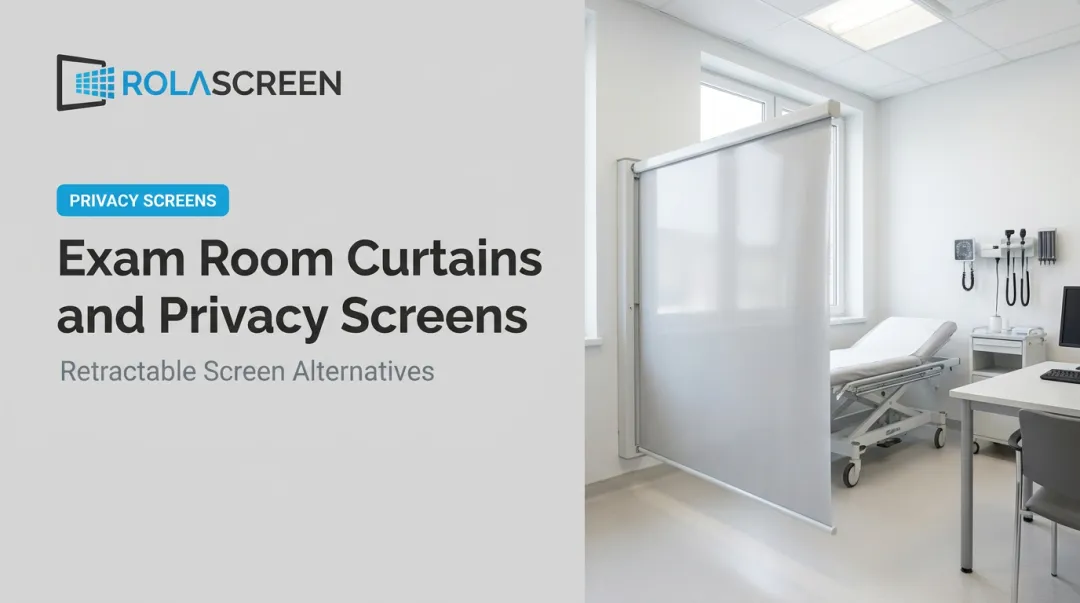
- Wall-mounted retractable screens — permanently installed units that mount flush to the wall and extend outward when needed, consuming zero floor space when retracted
Retractable models can also flex and curve along their width to conform to non-linear room layouts — useful for wrapping around a patient bay corner or creating an L-shaped privacy zone in a hallway using a single unit.
Infection-Control Advantage
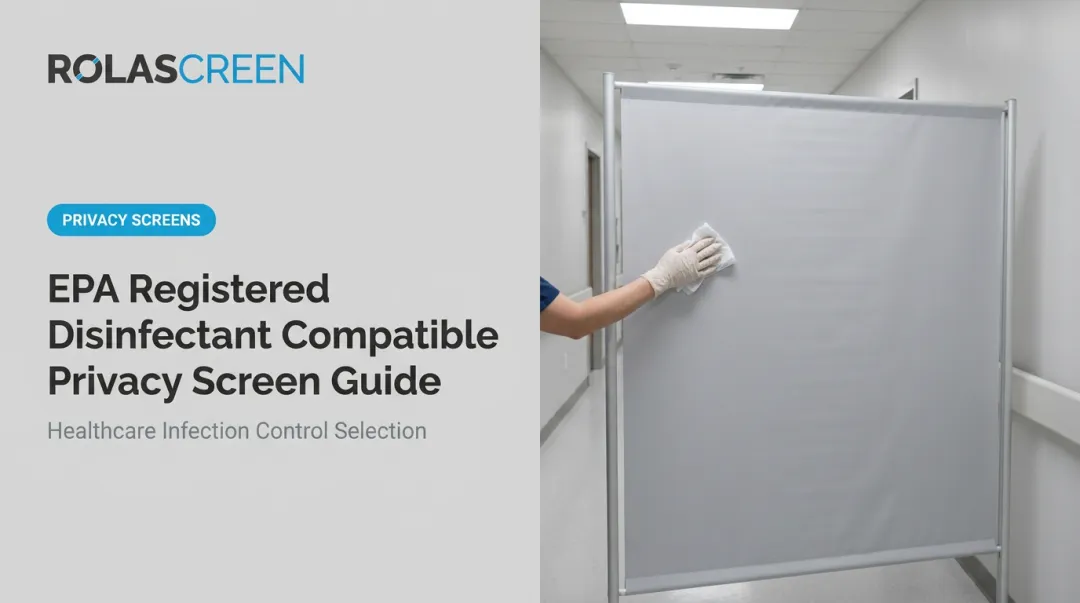
Non-porous, hard or coated surfaces fit into standard hard-surface wipe-disinfection workflows. Unlike fabric curtains, they don't require removal for laundering — a staff member can wipe the surface with an EPA-registered hospital disinfectant between patient encounters, using the same workflow applied to overbed tables and bedrails.
As APIC classifies privacy curtains as healthcare textiles requiring a separate laundering pathway, non-porous screens eliminate that pathway entirely for privacy barriers.
No published study has directly compared HAI rates between fabric curtains and wipeable privacy screens. What the evidence does support is a reprocessing workflow advantage, not a proven clinical outcome difference. The documented contamination burden on fabric curtains is substantial, and the ability to disinfect between patients without removing the barrier is a genuine infection-control gain.
Operational Flexibility
This is where screens genuinely outperform curtains:
- Deploy, reposition, or store a screen in under a minute
- Convert non-clinical spaces — cafeterias, gymnasiums, corridors — into infection-controllable bays without construction
- Reconfigure surge capacity areas as patient flow changes without reinstallation
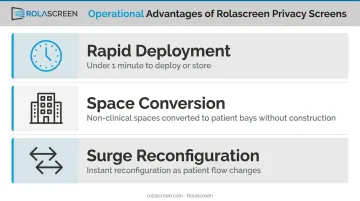
For facilities managing fluctuating census, surge events, or multi-use spaces, that speed matters.
Customization Options
Privacy screens can incorporate high-resolution branded imagery, calming artwork, department wayfinding, or patient education content — printed directly onto interchangeable panels. This is a patient experience benefit curtains rarely match at the same quality level. Screens from manufacturers like Rolascreen support custom panel printing, multiple frame color options, and optional antimicrobial finishes for high-acuity environments.
Use Cases for Hospital Privacy Screens
Ideal for:
- Emergency departments, urgent care, and triage areas
- ICUs, isolation bays, and contact-precaution rooms
- Open-plan therapy, dialysis, and infusion centers
- VA and military facilities with Buy America procurement requirements
- Surge environments, disaster shelters, and mobile health settings
- New facility buildouts where ceiling track installation would add unnecessary cost
Hospital Curtains vs. Privacy Screens: Which Is Better?
Rather than declaring a universal winner, the better approach is asking four questions specific to your situation:
- How frequently does this space need to be reconfigured?
- What is the infection-control standard for this area?
- Is ceiling track infrastructure already in place, or would it need to be installed?
- What is the true total cost of ownership over 3–5 years — including laundering, replacement, and staff labor?
Infection Control Verdict
For areas where multidrug-resistant organism (MDRO) risk is elevated — ICUs, burn units, contact-precaution rooms, emergency departments — wipeable privacy screens offer a stronger reprocessing workflow. Fabric curtains in these environments require laundering cycles that may not keep pace with documented contamination rates, especially given how quickly MRSA establishes on fabric surfaces.
Flexibility Verdict
Screens win decisively for any space that needs to adapt quickly. Curtains are fixed to their ceiling track. Once installed, repositioning requires reinstallation. Screens move in seconds — a meaningful operational advantage during surge events, seasonal census spikes, or multi-purpose space conversions.
Cost Verdict
Curtains appear cheaper upfront. Factor in the full picture, though:
- Laundering costs run approximately $3.61 per panel per cycle
- Staff time for removal, bagging, and reinstallation adds up across a high-change-frequency ward
- Replacement schedules and laundry-dependent infection-control logistics add overhead most facilities underestimate
Privacy screens carry higher initial investment but a lower ongoing maintenance burden, particularly over a 3–5 year horizon.
One caveat: no published TCO study directly compares curtains to screens at scale. Facility-specific modeling — using your own panel counts, laundry contract rates, change frequency, and screen pricing — will produce the most accurate estimate for your procurement decision.
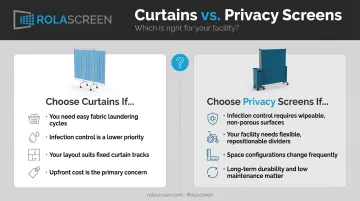
Situational Guidance
| Choose Curtains If... | Choose Privacy Screens If... |
|---|---|
| Ceiling track infrastructure already exists | Infection control is a primary driver |
| You have strong in-house laundry operations | Space layout changes frequently |
| Permanent multi-bed inpatient ward | Setting up a new area without existing track |
| Budget for upfront cost is the primary constraint | Rapid deployment or surge capacity is needed |
Real-World Example: Privacy Screens in Action
During COVID-19, Rolascreen supplied over 200 screens to VA and military facilities across the country — including the Wilmington VA Medical Center, Moncrief Army Health Clinic, VA Gulf Coast, and the U.S. Army Medical Research Institute. The challenge was consistent: surge capacity demand, high infection-control standards, and the need for fast deployment without construction.
Retractable screens were chosen over curtains for three converging reasons:
- Non-porous panel surfaces wiped down between patient encounters using bleach solutions up to 10,000 ppm — the concentration required against C. difficile spores
- Units deployed in seconds, converting corridors and non-clinical spaces into functional patient bays within hours, with no installation required
- Chatsworth, California manufacturing qualified Rolascreen for Buy America Act procurement, where foreign-manufactured products face compliance friction
- Screens repositioned as patient flow changed and disinfected between uses, eliminating the laundry workflow curtains would have required
Speed in the Field: Florida Disaster Shelter Deployment
50 Portable Elite units were delivered to the Florida Department of Health within 4 weeks for hurricane disaster shelters, where screens created designated family privacy zones within open gymnasium-style spaces. No ceiling track, no facility modification, no installation crew required.
Both product lines are designed for single-staff operation:
- Portable Elite: extends to 10 feet 3 inches wide, retracts to a 9-inch storage unit, deployed or stored in under a minute
- Wall-Mounted Elite: mounts flush to the wall, extends up to 18 inches outward when in use, preserving floor space in exam rooms, dialysis bays, and semi-private rooms
If your facility is evaluating privacy solutions for an ED, open clinic, surge environment, or any space where infection control and flexibility are priorities, Rolascreen's team can help you identify the right screen configuration for your specific layout and compliance requirements.
Conclusion
Hospital curtains remain a practical solution for established inpatient wards with existing ceiling track infrastructure, adequate laundry capacity, and stable space layouts. They are familiar, code-compliant, and widely available.
Privacy screens offer a measurably stronger case for infection control, disinfection and turnover workflows, operational flexibility, and total cost of ownership in most modern healthcare environments — particularly emergency departments, surge settings, dialysis centers, and any area where MDRO risk is elevated or space reconfiguration is routine.
Rising HAI rates, tighter Joint Commission scrutiny, and shrinking floor plans have made rapid deployment and same-shift disinfection table stakes — not optional upgrades. The right choice comes down to your facility's infection-control protocols, space constraints, and total cost picture over a 3-5 year horizon.
Quick decision guide:
- Stable inpatient wards with ceiling tracks already installed → curtains remain cost-effective
- Emergency departments, surge capacity, or high MDRO-risk areas → privacy screens reduce cross-contamination risk and cut laundry overhead
- Dialysis centers, outpatient clinics, or spaces that reconfigure frequently → portable or wall-mounted screens deliver the flexibility curtains can't match
Frequently Asked Questions
How often do hospital curtains need to be changed?
CDC recommends laundering curtains when visibly soiled, with the schedule set by environmental services and infection-control staff — no universal interval is mandated. One military hospital study used a six-month routine cycle, plus immediate laundering after contact or droplet precaution discharges. High-risk areas often require more frequent changes, which is driving many facilities toward wipeable privacy screens.
What are hospital curtains called?
Hospital curtains are commonly called cubicle curtains, nurse curtains, or privacy curtains. They are fabric dividers suspended from ceiling-mounted tracks and are standard in multi-bed inpatient wards and emergency departments.
Why do hospital curtains have mesh at the top?
The mesh section is required by NFPA 13 to allow ceiling sprinkler water to penetrate the curtain in the event of a fire. Under the 2019 edition, the mesh must be at least 70% open and extend at least 22 inches down from the ceiling to qualify for the light-hazard obstruction exception.
What are alternatives to hospital curtains?
The main alternatives include retractable and portable privacy screens, smart glass partitions, and folding panel dividers. Privacy screens are the most practical alternative for most facilities — they require no ceiling track installation, support standard disinfection workflows, and can be deployed or repositioned without construction.
Are hospital privacy screens HIPAA compliant?
Privacy screens qualify as a reasonable physical safeguard under HHS HIPAA guidance, which recognizes cubicles, dividers, and similar barriers as appropriate protections during consultations or examinations — especially in open-plan clinics, waiting areas, or telehealth setups. That said, no single product makes a facility HIPAA compliant; compliance depends on the facility's broader policies and practices.
Can privacy screens fully replace curtains in an emergency department?
In many ED layouts, yes. Retractable or portable privacy screens can replace curtains effectively — they offer faster repositioning between patient encounters, easier disinfection, and no dependence on ceiling track infrastructure. For high-turnover environments with strict infection-control demands, those are practical advantages over fabric curtains.