Introduction
Sneeze guards have been a food service fixture for over 60 years — yet facility managers routinely fail health inspections because they misread which rules actually apply to their setup.
The confusion is understandable — multiple regulatory bodies are involved (FDA, OSHA, NSF, state and local health departments), and they don't all speak the same language. A buffet operator faces hard legal requirements. A retail checkout counter faces something closer to advisory guidance. A hospital reception desk sits somewhere in between.
This guide cuts through that complexity. It covers:
- Which regulations actually apply and who enforces them
- Height, sizing, and placement standards from NSF/ANSI 2-2014
- Setting-by-setting requirements (food service, healthcare, retail, and office)
- Material and construction standards
- A practical compliance checklist to use before and after installation
Key Takeaways
- Sneeze guards are legally required for open food displays under FDA Food Code Section 3-306.11
- NSF/ANSI 2-2014 is the primary design benchmark — many health departments use it directly
- Sneeze guard height standard: 4.5–5 feet above the floor (based on average mouth height)
- OSHA guidance recommends barriers in non-food workplaces, but state rules vary
- Always verify requirements with your local health department before purchasing
What Are Sneeze Guards and When Are They Required?
Sneeze guards — also called food shields or breath guards — are transparent barriers made from acrylic, polycarbonate, or glass. They block respiratory droplets, bacteria, and airborne contaminants from reaching exposed food, work surfaces, or people on the other side of a counter.
A Brief Origin Story
The modern sneeze guard traces back to western Pennsylvania entrepreneur John P. Garneau. According to the Smithsonian, one of the first guards appeared at his American Style Smorgasbord restaurant in Monroeville in 1958, and Garneau filed the patent — USD186927S, titled "Covered food serving table" — on March 10, 1959. This is a long-established compliance area, not a COVID-era invention.
The Legal Line: Required vs. Recommended
There's an important distinction between settings where sneeze guards are legally required and those where they're strongly recommended.
Legally required (via adopted FDA Food Code):
- Self-service food bars and buffets
- Salad bars and cafeteria-style service lines
- Consumer self-service stations with open food
- Portable food carts with exposed food displays
Strongly recommended but not universally mandated:
- Retail checkout counters
- Office reception desks
- Non-food customer-facing environments
The categories above trace back to FDA Food Code 2022 Section 3-306.11, which requires that food on display be protected from contamination by packaging, counter/service-line/salad-bar food guards, display cases, or other effective means. Food guards are one named compliance method — not the only option, but the most common.
One critical point: the FDA Food Code is a model code, not automatic federal law. Its requirements only become enforceable when adopted by a state, county, or tribal jurisdiction.
That means your local health department is typically the actual enforcement authority — and their requirements may go beyond the federal model. Contact them before making purchasing decisions.
The Regulatory Framework: FDA, OSHA, NSF/ANSI, and ServSafe
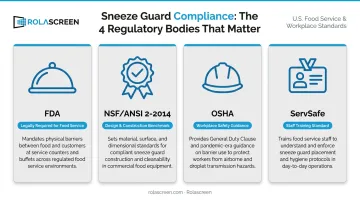
Sneeze guard compliance draws from four distinct regulatory bodies — each covering a different aspect of food safety, workplace safety, or equipment design.
FDA Food Code
Section 3-306.11 is the core requirement for food service settings. Related sections also apply:
- 3-306.12 — condiments must be in protective dispensers or covered displays
- 3-306.13 — raw unpackaged animal food is restricted in consumer self-service; ready-to-eat self-service foods require suitable dispensing methods and trained monitoring staff
Violations documented during health inspections can directly affect a facility's ability to pass and remain operational.
NSF/ANSI 2-2014
This is the industry's primary design benchmark for food equipment and sneeze guards. The 2014 revision updated food-shield requirements in Sections 5.35.1 through 5.35.8, covering barrier height, placement, splash-zone radius, single and multi-tiered configurations, glass edge requirements, and counter measurements.
NSF/ANSI 2-2014 is not automatic federal law, but it functions as the compliance yardstick most local health departments use during plan reviews and inspections. Morgan County, Indiana, for example, explicitly requires that all new food equipment meet or be equivalent to current NSF standards.
NSF certification means a product has been independently tested against these sanitary design criteria. Certified products generally move through health inspections more smoothly because the third-party verification is already on file.
It's the safest choice for demonstrating due diligence, even though it's not a universal federal requirement.
ServSafe's Role
ServSafe, the food safety training program run by the National Restaurant Association, teaches food handlers that sneeze guards are a primary physical barrier against contamination of displayed food. The official ServSafe sample chapter instructs staff to keep food under the sneeze guard and act immediately when a contamination problem is identified.
That connection between compliance and training matters in practice: an NSF-certified guard that staff ignore or fail to report when damaged provides little real protection.
OSHA
OSHA has no specific sneeze guard regulation equivalent to the FDA Food Code requirement. However, Section 5(a)(1) of the OSH Act — the General Duty Clause — requires employers to maintain a workplace free from recognized hazards. OSHA's guidance (including guidance issued during COVID-19) recommends transparent shields or barriers at fixed workstations where physical distancing isn't feasible.
That guidance explicitly states it creates no new legal obligations, but it can still be cited in enforcement actions under the General Duty Clause. For retail and office environments, state-level occupational safety regulations are often the more direct compliance reference.
Sneeze Guard Height, Sizing, and Placement Requirements
Height requirements aren't arbitrary. They're derived from a specific physical principle: the guard must intercept the direct line between the average customer's mouth and the exposed food or surface below.
Self-Service Sneeze Guard Dimensions
Two official local health sources provide the most widely cited benchmarks:
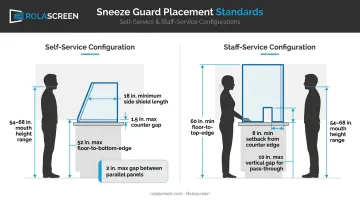
- Maricopa County (Arizona): average customer mouth height of 4.5–5 feet above the floor
- Riverside County (California): mouth zone range of 54–68 inches from the floor, with a maximum 52-inch floor-to-bottom-edge measurement
Both jurisdictions base their guidelines on NSF/ANSI Standard 2. Riverside County adds:
- Side shields must be at least 18 inches long with a maximum 1.5-inch gap to the counter
- Maximum open space between adjacent parallel panels: 2 inches
Self-service guards (buffets, salad bars) are typically angled to account for customers leaning over food. Staff-service guards are positioned differently since employees work behind the counter rather than reaching across it. NSF/ANSI 2-2014 specifies angular and positional requirements for both configurations.
Counter and Desk-Level Sneeze Guard Sizing
The same core logic applies to countertop and desk-mounted guards: the barrier must protect a seated or standing customer and cover the full width of the transaction zone.
Two practical requirements to keep in mind:
- Pass-through openings should be as small as functionally possible per OSHA barrier guidance — no universal "4-inch gap" standard exists in federal or NSF sources, so confirm with your local health authority
- Guard clarity matters: cloudy or scratched panels can create compliance risk if they impair effective protection or cleanability — replace damaged guards promptly
Sneeze Guard Requirements by Setting
Food Service: Buffets, Cafeterias, and Self-Service Stations
Food service faces the most stringent requirements. FDA Food Code Section 3-306.11 requires protection for all open food displays — and most local health departments use NSF/ANSI 2-2014 as their specific design benchmark when reviewing plans and conducting inspections.
Key requirements for this setting:
- All open food displays must have guards, display cases, or equivalent protection
- Guards must intercept the line between customer mouth height and food
- Self-service operations must be monitored by trained food employees
- Condiment stations require protective dispensers or covered displays
Health inspectors document non-compliance during routine inspections, and violations can directly affect a facility's operating status.
Healthcare and Clinical Environments
Unlike food service, healthcare has no single federal sneeze guard mandate. Reception desks, check-in windows, pharmacy counters, and triage areas commonly use counter-mounted guards, but the requirements come from infection control standards, state health codes, and internal accreditation requirements rather than one unified rule.
Point-of-entry barriers are typically one layer of a broader infection control strategy. Many clinical environments require space separation that a fixed sneeze guard can't address:
- Open wards and multi-patient treatment bays
- Emergency department triage areas
- Dialysis and infusion stations
- Surge capacity areas that need rapid reconfiguration
For these settings, retractable privacy screens and portable room dividers serve as a complementary layer — creating separation between patients without permanent construction. Rolascreen supplies retractable screens to healthcare facilities across these applications, including VA hospitals and large health systems.
Retail, Office, and Other Commercial Settings
No single federal mandate for sneeze guards exists in non-food commercial environments. The relevant framework is:
- OSHA General Duty Clause — requires protection from recognized workplace hazards
- OSHA COVID-era guidance — recommended transparent shields at fixed workstations, though this guidance is not a binding regulation
- State-specific workplace safety orders — many states introduced or reinforced barrier requirements during COVID-19; check whether current versions remain in effect for your industry and state
Review your state's current occupational safety regulations before concluding that barriers are optional for your setting.
Material and Construction Standards
FDA Food Code equipment provisions set performance requirements for all food-contact and food-adjacent surfaces. Compliant materials must be:
- Safe, durable, and corrosion-resistant
- Nonabsorbent and smooth
- Easily cleanable
- Resistant to pitting, chipping, crazing, scratching, scoring, distortion, and decomposition
Common Compliant Materials
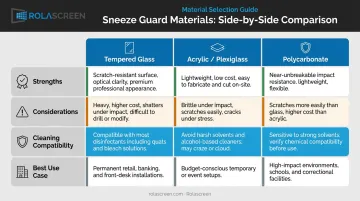
| Material | Strengths | Considerations |
|---|---|---|
| Tempered glass | Scratch-resistant, durable, preferred for permanent installations | Heavier; exposed edges must be chip-protected per NSF guidelines |
| Acrylic (plexiglass) | Lightweight, easy to customize, cost-effective | More prone to scratching over time; verify disinfectant compatibility |
| Polycarbonate | High impact resistance, good for high-contact environments | Can stress-crack when certain disinfectants combine with mechanical strain |
Cleaning Chemical Compatibility
Testing by Plaskolite and Curbell Plastics found that soap and water or hydrogen peroxide disinfectants generally work best on acrylic and polycarbonate sheet products. Polycarbonate is vulnerable to environmental stress cracking when tensile stress combines with certain cleaning chemicals — and acrylic faces similar risks.
Practical guidelines for chemical compatibility:
- Match material to cleaning chemistry before purchase, not after installation
- Keep the manufacturer's chemical compatibility data on file for inspections
- Replace any guard that yellows, crazes, or cracks — degraded surfaces fail FDA cleanability requirements
Stability Requirements
Guards must maintain effective protection throughout service. A guard that can be pushed aside by a customer or staff member fails to provide consistent protection and will flag during inspections.
Permanent counter-mounted units should be secured to the counter surface. Freestanding units need a base weighted or designed to prevent casual displacement. NSF/ANSI 2-2014 and local plan review requirements address construction stability as part of the overall food shield design criteria.
Practical Compliance Checklist
Use this checklist to stay audit-ready — from initial planning through ongoing operations.
Pre-Installation
- Contact your local health department to obtain jurisdiction-specific sneeze guard requirements before purchasing
- Confirm the product meets NSF/ANSI 2-2014 standards or local equivalents
- Measure the full food display or counter zone to ensure complete coverage
- Verify the guard height accounts for your average customer's mouth height (54–68 inches from the floor)
- Confirm the guard will not obstruct required customer visibility of food and staff
- For healthcare or clinic settings, confirm whether your jurisdiction requires partition height or material specifications beyond standard food-service rules
Ongoing Maintenance
- Establish a regular cleaning schedule using disinfectants compatible with the guard's material
- Inspect regularly for cracks, deep scratches, cloudiness, or structural instability
- Replace damaged guards promptly — degraded surfaces are a compliance violation
- Document all maintenance activities for health inspection records
Common Compliance Failures to Avoid
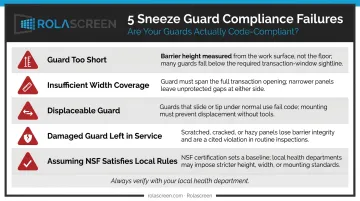
- Guards too short for the average customer's mouth height
- Guards that don't cover the full width of the food display
- Portable or swinging guards that can be displaced during service
- Damaged guards left in service after visible deterioration
- Assuming NSF/ANSI 2-2014 satisfies all local requirements — always verify directly with your health department
Frequently Asked Questions
Are sneeze guards required by law?
Sneeze guards are legally required for self-service food displays, buffets, and cafeterias under FDA Food Code Section 3-306.11, once that code is adopted by a jurisdiction. In non-food settings like offices and retail, they're strongly recommended by OSHA but enforced primarily through state and local workplace safety regulations rather than a single federal mandate.
What is the purpose of a sneeze guard according to ServSafe?
ServSafe identifies sneeze guards as a critical physical barrier that prevents customers from contaminating open food displays through coughing, sneezing, or talking. ServSafe-trained staff are taught to keep food positioned under the guard and to act immediately when contamination risks are identified.
What are the sneeze guard height requirements?
Height requirements derive from NSF/ANSI 2-2014 and require the guard to intercept the line between the average customer's mouth (approximately 54–68 inches above the floor) and the exposed food. Exact dimensions vary by guard type and local health department requirements.
Do sneeze guards need to be NSF certified?
NSF certification is not a universal federal requirement, but it is the most widely accepted industry standard. Many local health departments reference NSF/ANSI 2-2014 during inspections, making certified products the safest choice for passing inspections.
What materials are best for sneeze guards?
Compliant sneeze guard materials must be non-porous, smooth-surfaced, and able to withstand repeated disinfection. Tempered glass and acrylic are widely used; clear polymer panels are another option. Before purchasing, verify that your facility's cleaning products are chemically compatible with the specific material.
How often should sneeze guards be cleaned or replaced?
Clean according to your facility's standard sanitization schedule, using disinfectants verified as compatible with the guard's material. Replace when visible damage appears — cracks, deep scratches, cloudiness, or structural instability can all flag violations during health inspections.