Key Takeaways
- Clean before you disinfect — removing debris first makes disinfectants more effective
- Never use ammonia-based cleaners (including Windex) on acrylic or polycarbonate surfaces
- Use microfiber cloths only — paper towels cause micro-scratches that accumulate over time
- Match cleaning frequency to setting — healthcare environments need between-patient disinfection, not just daily wipe-downs
- Inspect mounting hardware regularly — a structurally compromised barrier is a hygiene problem, not just a safety one
Sneeze guards do a simple job: sit between people and intercept respiratory droplets. But that same function means the surface collects exactly what you're trying to stop — and a contaminated barrier can become a transmission point rather than a prevention tool.
Many facilities treat sneeze guard cleaning as a quick wipe whenever something looks dirty. That approach creates two problems: surfaces degrade faster from improper products, and pathogens persist longer than most people expect.
Influenza A and B survive 24–48 hours on hard non-porous plastic surfaces, and SARS-CoV-2 demonstrated viability on plastic for up to 72 hours under experimental conditions.
This guide covers why consistent maintenance matters, what cleaning and disinfecting actually require, a step-by-step process, what to avoid, warning signs, and a practical frequency schedule.
Why Cleaning Sneeze Guards Regularly Matters
A sneeze guard that looks clean isn't necessarily safe. One cleaned with the wrong products may look intact while being structurally compromised underneath.
Surface Clarity Is a Function Issue
Scratches, hazing, and cloudiness are not just cosmetic. They reduce visibility through the barrier, which defeats one of its core purposes: allowing clear communication between staff and patients or customers. In healthcare check-in, pharmacy windows, and triage desks, reduced clarity creates real operational friction.
Contaminated Surfaces Defeat the Point
OSHA identifies clear plastic sneeze guards as physical barriers that provide additional worker protection, but only when properly maintained. A surface that harbors pathogens doesn't contain transmission; it facilitates it.
CDC environmental cleaning guidance treats high-touch surfaces as requiring more frequent and rigorous cleaning than low-touch surfaces — with frequency tied to contamination risk and patient vulnerability.
Wrong Products Cause Irreversible Damage
Ammonia and acetone dissolve PMMA acrylic. Plaskolite's chemical compatibility data for OPTIX acrylic lists both as "dissolved." Once micro-cracking or crazing (hairline surface fractures) begins, it cannot be reversed by cleaning. The result is early replacement, which costs far more than consistent preventive maintenance with approved products.
Not all barrier materials carry this risk equally. Rolascreen's Guard partitions use non-porous wipeable surfaces engineered for compatibility with EPA-registered hospital disinfectants, removing much of the guesswork around chemical compatibility. That said, the principles below apply across all clear barrier materials.
Chemicals that damage acrylic sneeze guards:
- Ammonia-based cleaners (including many glass cleaners)
- Acetone and ketone solvents
- Bleach at undiluted concentrations
- Abrasive powders or scrub pads
Types of Sneeze Guard Maintenance
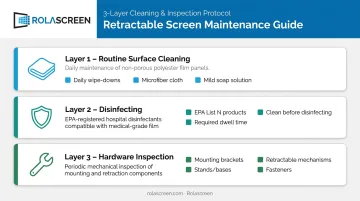
Sneeze guard maintenance has three distinct layers. Surface cleaning alone isn't sufficient.
Routine Surface Cleaning
Daily or per-use wipe-downs form the foundation. The goal is mechanical removal of fingerprints, dust, smudges, and visible debris using a microfiber cloth and a mild soap-and-water solution. This step matters beyond hygiene: debris left on the surface gets ground in during disinfection wipes, causing scratches that accumulate over time.
Disinfecting
Disinfecting is chemically distinct from cleaning. Where cleaning removes visible soil, disinfection kills pathogens on the surface. EPA List N disinfectants are validated to kill SARS-CoV-2 when label directions are followed, including the required contact time: the surface must stay visibly wet for the full dwell period.
Disinfecting a dirty surface is less effective because organic matter neutralizes the chemical agent — which is why cleaning must always come first.
Preventive Inspection and Hardware Maintenance
Periodic checks catch problems before they become failures. Inspect these components on a regular schedule:
- Mounting brackets for looseness or wall-pull separation
- Stands and bases for stability and level footing
- Retractable mechanisms for smooth, full extension and retraction
- Fasteners for corrosion, stripping, or missing hardware
A barrier that wobbles, leans, or doesn't retract cleanly is compromised even if the surface is spotless. Physical gaps in coverage can't be fixed with a cleaning schedule.
How to Clean Sneeze Guards: Step-by-Step
Materials needed:
- 2 microfiber cloths (one for cleaning, one for drying/buffing)
- Mild dish soap diluted in warm water
- Approved disinfectant (compatible with the guard's material — acrylic, polycarbonate, or non-porous polyester film)
- Plastic-safe polish such as Brillianize (optional, for acrylic/polycarbonate)
- Disposable gloves for healthcare or high-risk environments
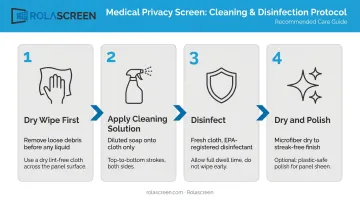
Step 1 — Dry wipe first
Remove loose dust and debris with a dry microfiber cloth before applying any liquid. Applying a wet solution to a dusty surface risks grinding particles into the material and causing scratches.
Step 2 — Apply cleaning solution
Spray the diluted soap solution onto the microfiber cloth — not directly onto the surface. Direct spraying can push liquid into seams, brackets, or retractable mechanisms. Wipe in gentle, overlapping strokes from top to bottom. Clean both sides.
Step 3 — Disinfect
Apply the disinfectant to a fresh microfiber cloth and wipe all surfaces — both sides of the guard. Allow it to dwell for the contact time listed on the product label.
⚠ Do not wipe dry prematurely. Dwell time is when the disinfectant actually kills pathogens. Wiping early renders the step ineffective.
Step 4 — Dry and polish
Once dwell time is complete, remove all remaining moisture with a clean, dry microfiber cloth. For acrylic or polycarbonate surfaces, a small amount of Brillianize buffed in gently can remove fine scratches and haze while reducing static cling that attracts dust. This step is optional but extends time between cleanings in high-traffic areas.
What to Avoid When Cleaning Sneeze Guards
Wrong products and poor application habits cause most sneeze guard damage — scratching, hazing, and stress cracking are largely preventable. Here's what to keep away from your barriers.
Products to Never Use
| Product | Why It's Harmful |
|---|---|
| Ammonia-based cleaners (Windex, many glass sprays) | Dissolves PMMA acrylic; causes micro-cracking and hazing |
| Acetone | Listed as "dissolved" in Plaskolite acrylic chemical compatibility data |
| Undiluted isopropyl alcohol on acrylic | Can cause stress cracking; Plaskolite TUFFAK polycarbonate tolerates IPA up to 30% |
| Abrasive cleaners or scouring pads | Create permanent surface scratches |
Note on IPA: Acrylic tolerance thresholds for isopropyl alcohol are not universally standardized — check your specific manufacturer's chemical compatibility data before use.
Application Mistakes That Damage Surfaces
- Spraying directly onto the barrier: liquid migrates into seams and mechanisms
- Using paper towels: their fiber structure micro-scratches clear plastic surfaces, even when they feel soft; ACRYLITE manufacturer guidance specifically recommends a clean, soft cloth with light pressure
- Leaving disinfectant past the specified dwell time: can cause discoloration or surface stress on sensitive materials
- Pooling water near structural components: accelerates corrosion of metal hardware
Signs Your Sneeze Guard Needs Attention or Replacement
Not every issue requires replacement, but knowing which ones do saves money — and prevents a false sense of security.
Surface Warning Signs
- Persistent haze or cloudiness that doesn't clear after polishing — indicates micro-scratch accumulation or chemical damage
- Deep scratches impairing visibility through the panel
- Yellowing from UV exposure — affects clarity and indicates material aging
- White stress marks (crazing) near edges — crazing in continuous cast acrylic results from stress combined with chemical exposure; it cannot be reversed and indicates the material is structurally weakened
Structural Warning Signs
- Wobbling, leaning, or shifting after installation
- Difficulty extending or retracting the mechanism
- Visible corrosion on metal brackets or fasteners
- Fasteners that won't hold torque when tightened
When Replacement Is the Only Option
Cracks, chips, or significant crazing compromise structural integrity and cannot be safely repaired. A guard with these issues provides no reliable barrier protection — the surface damage creates irregular areas where pathogens can accumulate, resistant to standard wiping. Using a damaged guard turns a safety measure into a contamination source.
Sneeze Guard Cleaning Frequency and Maintenance Schedule
Frequency depends on the environment. A sneeze guard at a hospital ED triage window and one at a low-traffic corporate reception desk require fundamentally different schedules.
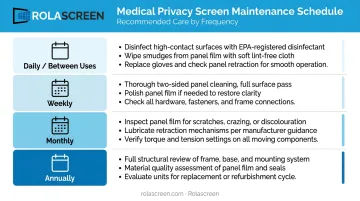
| Frequency | Tasks |
|---|---|
| Daily / between uses | Disinfect all high-contact surfaces; wipe visible smudges; replace gloves between patients in clinical settings |
| Weekly | Thorough cleaning of both surfaces; polish acrylic/polycarbonate if needed; check mounting hardware for looseness |
| Monthly | Inspect for scratches, crazing, or yellowing; clean and lubricate retractable mechanisms; verify hardware torque |
| Annually | Full structural review; evaluate whether material quality still meets facility safety requirements; assess whether replacement is more cost-effective than continued maintenance |
Healthcare-specific note: In hospitals, urgent care clinics, and vaccination sites, "daily" is not sufficient. CDC environmental cleaning guidance breaks it down by setting:
- Consultation and examination areas: at least twice daily
- ICUs: high-touch surfaces twice daily and as needed
- Contact and droplet precaution areas: at least twice daily plus as-needed cleaning
For these settings, treat the schedule above as a floor, not a ceiling, and follow your facility's infection control protocols.
Rolascreen's non-porous polyester film surfaces are validated for compatibility with bleach solutions up to 10,000 ppm, exceeding the CDC's 5,000 ppm sporicidal threshold for C. difficile disinfection and meeting the demands of aggressive clinical disinfection schedules.
Conclusion
Cleaning a sneeze guard isn't a single action — it's a multi-step discipline. Surface cleaning removes debris and disinfection kills pathogens, but neither matters without structural inspection to keep the barrier physically reliable. Timely replacement ensures a compromised guard doesn't give false confidence.
The tools and products you use matter as much as how often you clean. Ammonia on acrylic, paper towels on polycarbonate, and disinfectant left past its dwell time all cause damage that compounds over time and ultimately shortens product life. Following the right protocol consistently costs far less than reactive replacement.
For healthcare and commercial facilities needing partitions built for consistent, protocol-aligned maintenance, Rolascreen's Guard sneeze guards and retractable privacy screens feature non-porous wipeable surfaces engineered for hospital-grade disinfection. They integrate into standard terminal cleaning workflows without special handling requirements. Contact Rolascreen at 1-800-259-4214 or sales@rolascreen.com for product specifications and facility-specific guidance.
Frequently Asked Questions
Do sneeze guards prevent cross-contamination?
Sneeze guards reduce — but do not eliminate — cross-contamination. A 2022 laboratory study found barrier efficiency up to 93% under specific geometry conditions. Effectiveness depends on proper placement, adequate dimensions, and consistent cleaning; a contaminated surface can itself become a transmission point.
What is the purpose of a sneeze guard?
Sneeze guards create a physical barrier between people in shared spaces to reduce the spread of airborne droplets and contact contamination. They're used in healthcare check-in, food service, retail, and other high-contact environments where face-to-face interaction occurs frequently.
What cleaning products are safe to use on sneeze guards?
Mild dish soap and water, diluted bleach solutions, plastic-safe specialty cleaners like Brillianize, and EPA List N disinfectants are all appropriate options when used per label directions. Always avoid ammonia-based cleaners, acetone, and undiluted alcohol — and verify compatibility with your specific panel material before applying anything new.
How often should sneeze guards be cleaned?
At minimum, daily cleaning is appropriate for most settings. Healthcare environments should disinfect between patient interactions or shift changes, following CDC guidance for high-touch surfaces in clinical areas. Adjust your schedule to actual use patterns and patient vulnerability, not a fixed calendar interval.
Can you use alcohol wipes or bleach on a sneeze guard?
Diluted bleach and alcohol-based disinfectants work well on glass and polycarbonate at appropriate concentrations (Plaskolite TUFFAK polycarbonate tolerates IPA up to 30%). Acrylic is more sensitive — check manufacturer chemical-resistance data before use, as high concentrations or frequent application can cause stress cracking.
How do you remove scratches from a sneeze guard?
Light surface scratches on acrylic can often be buffed out with a plastic-safe polish like Brillianize or a plastic-formulated automotive polish. Deeper scratches that visibly impair clarity, or crazing that extends toward panel edges, indicate the guard should be replaced rather than repaired.