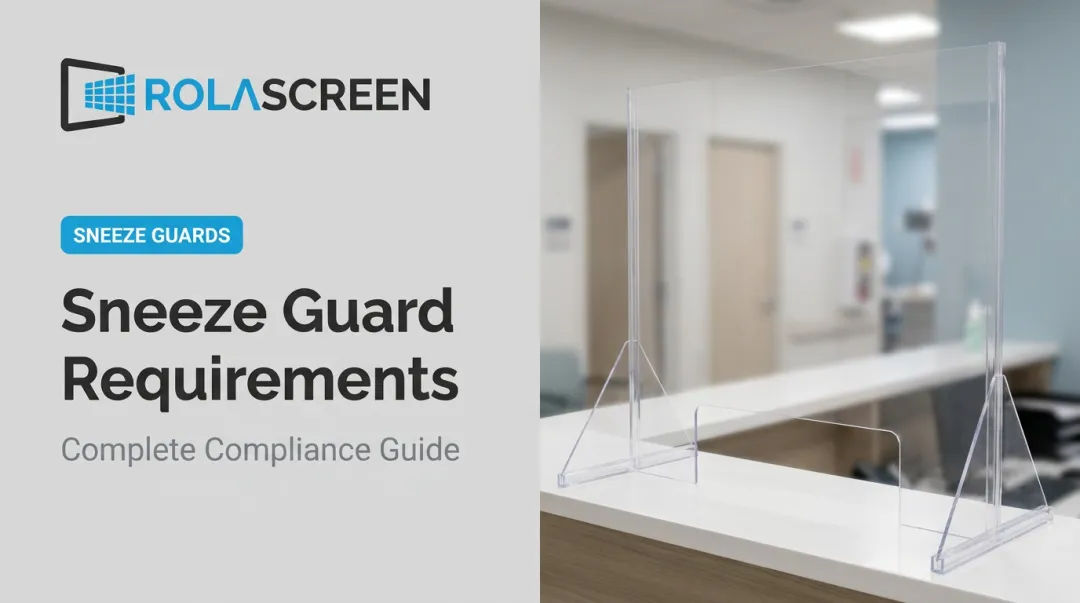
While "sneeze guard" is a familiar term in food service, its application has expanded well beyond buffet lines. Healthcare facilities, government offices, and corporate environments now treat physical barriers as a core part of their safety infrastructure — not a temporary fix. This article explains what a sneeze guard is, why it matters, the measurable benefits it delivers, and how to make it work in practice.
Key Takeaways
- A sneeze guard is a transparent physical barrier that intercepts respiratory droplets before they reach people or exposed surfaces
- Primary benefits: reduced pathogen transmission, regulatory compliance, and visible trust-building with occupants
- Required by law in most food service settings; required or strongly recommended in healthcare and institutional environments
- Placement height, surface cleanability, and coverage width determine real-world effectiveness
- In healthcare settings, barrier material must be compatible with EPA-registered disinfectants for effective infection control
What Is a Sneeze Guard?
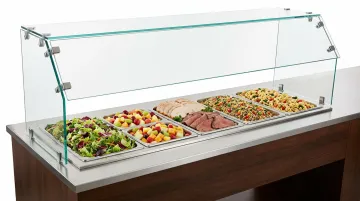
A sneeze guard is a physical barrier — typically made of acrylic, polycarbonate, or tempered glass — positioned between people or between a person and an exposed surface to block respiratory droplets from coughs, sneezes, or speech.
The term covers more product types than the name suggests:
- Countertop desk shields for reception desks and checkout stations
- Floor-to-ceiling room dividers for open-plan clinical spaces
- Hanging or ceiling-mounted panels for food service lines
- Retractable partition screens for environments that need reconfiguration
According to California's Retail Food Code, the functional requirement is straightforward: sneeze guards must "intercept a direct line between the consumer's mouth and the food being displayed." That same principle — blocking the direct exposure path — applies in every shared space, from hospital reception desks to school cafeterias.
Used correctly, a sneeze guard reduces the transmission risk at high-contact points without disrupting workflow or requiring structural changes to the space.
Key Benefits of Sneeze Guards
Benefit 1: Reducing Pathogen Transmission and Infection Risk
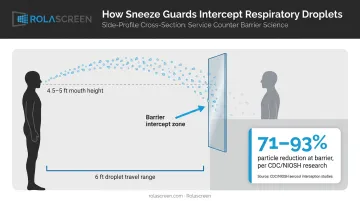
The core function of a sneeze guard is physical interception. A 2020 peer-reviewed review confirmed that large respiratory droplets can travel approximately 6 feet when a person coughs or sneezes — well within the range of most face-to-face service interactions. A properly placed barrier cuts that pathway before droplets reach the person or surface on the other side.
Placement determines whether a barrier actually works. The guard must intercept the direct line between an average person's mouth height (roughly 4.5–5 feet above the floor) and the exposed area. Width matters too — a narrow shield with open sides creates gaps that negate much of the protection.
In healthcare settings, the stakes are higher. CDC data shows that on any given day, about 1 in 31 U.S. hospital patients has at least one healthcare-acquired infection (HAI), and 1 in 43 nursing home residents is affected.
Physical barriers at reception desks, triage windows, and intake areas represent one layer of an engineering control strategy — particularly in high-turnover, limited-ventilation spaces where direct-contact exposure is hardest to avoid.
For facilities like Rolascreen's healthcare clients, surface cleanability matters as much as barrier placement. Non-porous panels compatible with EPA-registered disinfectants can be wiped down between patient encounters without degrading the surface.
Panels that accept bleach, quaternary ammonium compounds, and accelerated hydrogen peroxide are the practical standard. Porous or low-quality materials can harbor pathogens and provide false assurance.
Benefit 2: Regulatory Compliance and Legal Protection
In many settings, a sneeze guard isn't optional. FDA Food Code 2022, section 3-306.11, requires that food on display be protected by "packaging; counter, service line, or salad bar food guards; display cases; or other effective means." Most state health codes adopt or build on this model, and some — like California's Retail Food Code — go further by specifying the direct-line interception requirement explicitly.
Non-compliance carries real financial consequences:
| Jurisdiction | Violation Type | Fine Range |
|---|---|---|
| California | 1st offense | $50–$500 |
| California | 2nd offense (within 5 years) | $100–$1,000 |
| California | 3rd+ offense | $250–$2,500 |
| New York City | Food not protected from contamination | $200–$300 |
Beyond fines, the financial risk scales with the severity of the incident. A 2018 peer-reviewed simulation estimated that a single foodborne illness outbreak could cost a restaurant anywhere from $3,968 to over $2.6 million, depending on pathogen, outbreak size, and establishment type. Barrier investment is a fraction of that exposure.
In healthcare, CDC guidance explicitly recommends physical barriers at reception areas to limit close contact between triage staff and potentially infectious patients. No current CMS or Joint Commission regulation mandates sneeze guards by name, but engineering controls at patient intake points are a recognized expectation across both frameworks.
Benefit 3: Building Trust and Confidence Among Occupants
Compliance builds a baseline — visible safety measures build behavior. A 2022 Foods study of 1,697 consumers and 780 food-service businesses found that hygiene-related measures scored higher in importance than organizational measures. 69.3% of respondents returned to food service businesses after reopening, while 65% of those who delayed cited contamination risk as their primary reason.
When people can see that a facility takes contamination seriously, they're more likely to engage with it. For healthcare facilities, this matters even more. Patients who feel protected are more likely to show up, follow instructions, and return for follow-up care. Staff who work behind visible protective barriers report greater comfort in high-exposure roles.
Rolascreen's Guard partition line — deployed at reception areas and intake windows in hospitals, clinics, and institutional settings — addresses this perception gap directly. For facilities that already invest heavily in treatment-area safety, a cleanable barrier at the front desk closes the last exposed gap in the patient journey.
Where Are Sneeze Guards Most Commonly Used?
The traditional application is food service: buffet lines, salad bars, deli counters, and cafeteria stations where unpackaged food is exposed to the public. Food code compliance drives this use almost universally across U.S. jurisdictions.
Beyond food service, sneeze guards have become standard in a wide range of environments:
- Healthcare reception and triage — CDC recommends physical barriers at intake areas to separate triage staff from potentially infectious patients
- School nurse offices and testing centers — NYSED guidance specifically addresses plastic glazing for sneeze guards in school settings requiring face-to-face contact
- Government intake windows and checkout counters — GSA's workplace safety strategy includes physical barriers in federal facility planning
- Airport security checkpoints — TSA deployed acrylic barriers at San Antonio International Airport checkpoints to protect both staff and passengers
- Corporate reception areas — especially in open-plan offices with high visitor volumes
Healthcare presents a unique dual requirement: open-plan clinical environments, triage areas, and multi-use wards need infection control and patient privacy at the same time.
Rolascreen's retractable partition products address both functions in one unit. The Guard's non-porous panels block droplet transmission, while the opaque screen provides visual privacy, supporting HIPAA compliance without separate systems or room modifications.
How to Get the Most Value from Your Sneeze Guard Setup
The right product, poorly placed, still fails. Three factors determine whether a sneeze guard actually delivers its intended protection.
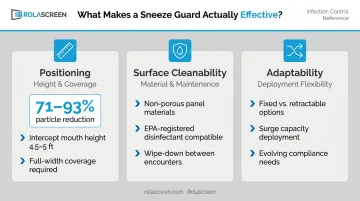
1. Positioning The barrier must intercept the direct line between the average person's mouth height (4.5–5 feet above the floor) and the exposed area. CDC/NIOSH lab research found that transparent barriers with tops at least 14 cm above cough height reduced small-particle counts by 71–86%, with the most effective configurations achieving up to 93% efficiency. Width coverage matters equally — open sides create lateral exposure gaps.
2. Surface Cleanability Positioning handles airborne exposure; material choice handles what settles on the surface. Key criteria:
- Non-porous surfaces resist biofilm formation and microbial adhesion
- Compatibility with EPA-registered disinfectants (bleach, quats, accelerated H2O2) ensures proper pathogen elimination
- Hard surfaces can be wiped down in minutes without degrading the barrier
Porous materials or surfaces that break down under hospital-grade disinfectants look protective while quietly harboring pathogens — a failure mode that's easy to miss and hard to reverse.
3. Adaptability Occupancy patterns shift, layouts get reconfigured, and compliance requirements evolve. Fixed barriers work well for permanent service points; portable or retractable options make more sense where reconfiguration is ongoing.
For healthcare environments managing surge capacity or multiple care models in the same space, the ability to redeploy barriers quickly is a genuine operational advantage.
Frequently Asked Questions
What is the primary purpose of a sneeze guard?
A sneeze guard physically blocks respiratory droplets — from coughs, sneezes, or speech — from reaching people or exposed food and surfaces nearby. It works by intercepting the direct path between a person's mouth and the exposure zone, reducing contamination risk in shared spaces.
Do I need a sneeze guard?
In food service with open displays, sneeze guards are legally required under FDA Food Code 3-306.11 and most state health codes. In healthcare and institutional settings, they're a strongly recommended engineering control. Check your local health department requirements — fines for non-compliance vary by jurisdiction.
What materials are sneeze guards made from?
The most common materials are acrylic (lightweight, impact-resistant), polycarbonate (flexible, fire-code compliant in certain jurisdictions), and tempered glass (durable, premium appearance). For healthcare settings, non-porous medical-grade film surfaces offer superior cleanability. The right choice depends on your cleaning protocols, durability requirements, and local code.
Where should a sneeze guard be positioned?
Position the guard to intercept the direct line between an average person's mouth height — roughly 4.5–5 feet above the floor — and the exposed area. The barrier should cover the full width of the exposure zone on the front and sides. Openings should be kept as small as possible and placed low.
How do you clean and maintain a sneeze guard?
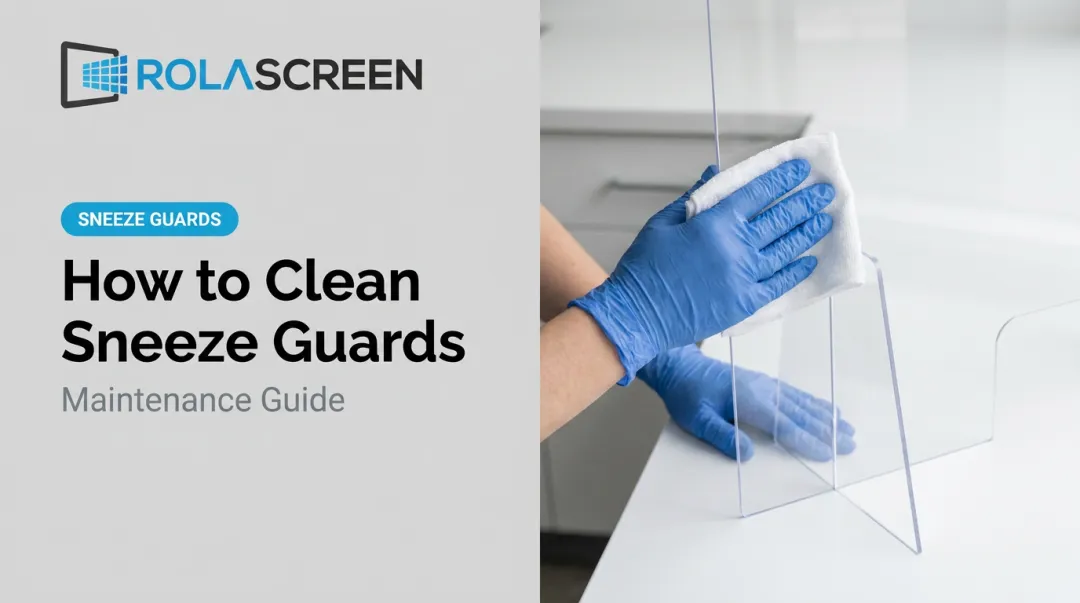
Wipe down regularly with a non-abrasive cloth — mild soap and water works for standard acrylic, while healthcare-grade non-porous surfaces can be cleaned with EPA-registered hospital disinfectants. High-turnover clinical settings should disinfect between each patient encounter.
What is the difference between a sneeze guard and a privacy screen?
Sneeze guards are transparent barriers focused on blocking respiratory droplets at service points. Retractable privacy screens used in healthcare serve dual functions — infection control and visual privacy — so a single unit can replace two separate barrier systems in clinical environments.