Introduction
Privacy screens in healthcare settings face a problem that fabric curtains make worse: they are high-touch, frequently shared surfaces that need regular disinfection — yet most aren't built for it.
Traditional fabric curtains absorb and trap pathogens between uses. Research published in Infection Control and Hospital Epidemiology found that 95% of hospital privacy curtains tested were contaminated at least once, with 21% harboring MRSA and 42% harboring VRE. Disinfecting fabric simply doesn't work the way it does on hard, non-porous surfaces.
There's a second problem: not every privacy screen can withstand the EPA-registered disinfectants required by hospital infection control protocols. Bleach degrades rubber, hydrogen peroxide discolors certain metals, and alcohol cracks plastics. Choosing the wrong screen — or the wrong disinfectant — creates both a compliance gap and an infection risk.
This guide covers what EPA registration actually means, how the four main disinfectant categories interact with different surface materials, and what to verify before purchasing a privacy screen for clinical use.
Key Takeaways:
- Look for an EPA Reg. No. on the label — "EPA-registered" is the correct compliance term
- Non-porous, wipeable surfaces are the only materials that support true disinfection
- The surface must stay visibly wet for the full contact time or disinfection fails
- Request manufacturer documentation confirming compatibility with your facility's disinfectants
- Fabric curtains require laundering or replacement — wipe protocols are not adequate
What Makes a Disinfectant "EPA-Registered"?
"EPA-registered" has a precise regulatory meaning — and it's stricter than most people assume. When the EPA registers a disinfectant, it has reviewed the manufacturer's testing data and confirmed that label claims — "kills MRSA," "effective against SARS-CoV-2" — are supported by evidence. Only after that review can a product legally make those claims.
"EPA-registered" is not the same as "EPA-approved." According to the EPA's pesticide registration guidance, the agency registers antimicrobial pesticides and verifies efficacy claims; it does not broadly "approve" products the way the FDA does with drugs.
How to Identify a Registered Product
Look for an EPA Reg. No. on the product label. Standard registration numbers use a two-part format: company number + product number (e.g., 70627-56 for Oxivir TB). Distributor (supplemental) products carry a three-part number, where the third set identifies the distributing company.
Matching Disinfectants to Pathogens
The EPA maintains pathogen-specific lists that matter enormously in healthcare procurement:
- List N — SARS-CoV-2 and emerging viral pathogens
- List K — Clostridioides difficile spores
- List H — MRSA and VRE
- List S — Bloodborne pathogens (HIV, Hepatitis B, Hepatitis C)
Selecting a disinfectant means matching it to the pathogens relevant to your specific care environment — a C. diff isolation room requires a List K product; a general patient bay may only need List H coverage.
Contact Time and the Cleaning-Disinfecting Distinction
Here's a step clinical teams routinely miss: the surface must remain visibly wet for the full labeled contact time. CDC guidance is explicit on this point. A surface wiped dry in 30 seconds when the product requires two minutes has not been disinfected.
Three terms also need to stay distinct:
- Cleaning — uses soap or detergent to remove organic material and reduce germ counts
- Sanitizing — reduces remaining germs on an already-cleaned surface
- Disinfecting — destroys or irreversibly inactivates bacteria, fungi, and viruses on hard surfaces
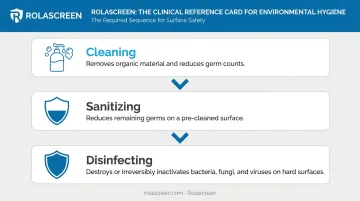
Cleaning always comes first. Blood, body fluids, and debris can neutralize a disinfectant before it ever contacts the pathogen.
Common Disinfectant Categories and Their Effects on Surfaces
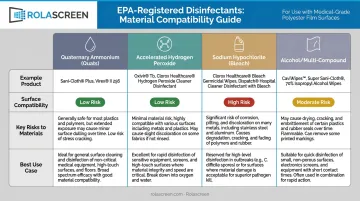
Four active ingredient categories dominate EPA-registered disinfectants in healthcare settings. Each interacts differently with the materials used in privacy screens.
Quaternary Ammonium Compounds (Quats)
Quats are among the most widely used disinfectants for noncritical surfaces in healthcare — floors, furniture, and medical equipment that contacts intact skin. CDC guidance identifies them as a standard chemical disinfectant category.
Common quat-based wipe products include:
- CaviWipes (EPA Reg. No. 46781-8) — quat + isopropanol, labeled for hard non-porous surfaces
- Super Sani-Cloth (EPA Reg. No. 9480-4) — quaternary ammonium + isopropyl alcohol
Quats generally have low corrosivity and good compatibility with most non-porous hard surfaces, making them a practical first-choice for routine privacy screen disinfection.
Hydrogen Peroxide-Based Products
Accelerated hydrogen peroxide (AHP) products like Oxivir TB (EPA Reg. No. 70627-56, active ingredient: 0.5% hydrogen peroxide) are increasingly common in healthcare for broad-spectrum effectiveness and shorter contact times.
The compatibility caveat: CDC notes that hydrogen peroxide has caused cosmetic and functional changes in certain equipment during compatibility testing — including discoloration of black anodized metal finishes. Material selection matters when AHP products are part of your rotation.
Sodium Hypochlorite (Bleach-Based) Products
Bleach-based products, such as Clorox Healthcare Bleach Germicidal Wipes (EPA Reg. No. 67619-12, 0.55% sodium hypochlorite), are the standard for C. diff spore destruction and other hardy pathogens.
The trade-off is surface compatibility. The Clorox EPA label explicitly states that prolonged contact with metal may cause pitting or discoloration and warns against use on non-stainless steel, aluminum, silver, or chipped enamel.
Any privacy screen with untreated metal frames or hardware used in bleach-disinfected environments requires explicit compatibility verification before routine use.
Alcohol and Multi-Compound Products
Alcohol-based and combination products (quat + isopropanol, like CaviWipes) are common for spot disinfection. The material risks per CDC:
- Can harden or crack rubber and certain plastics with repeated use
- Bleach rubber and plastic tiles
- Damage adhesive coatings on surfaces
- Evaporate rapidly, making it difficult to achieve full contact time — since prolonged wet exposure is harder to maintain unless items are immersed
On vertical surfaces like privacy screens, rapid evaporation is a real obstacle to achieving labeled contact times. That limitation — combined with the varying corrosivity of these four categories — is why material composition matters as much as disinfectant choice when evaluating privacy screen compatibility.
Why Surface Material Is the Deciding Factor
A disinfectant can be EPA-registered, correctly applied, and fully effective against its target pathogens — and still fail if the surface it's applied to is wrong.
The Fabric Curtain Problem
Porous textile fibers don't allow disinfectants to form consistent surface contact. They absorb liquids, trap pathogens within the weave, and cannot be adequately treated with wipe protocols. The data on this is consistent: in the Ohl et al. study, 95% of tested hospital privacy curtains were contaminated at least once during the observation period, with MRSA present on 21% and VRE on 42%.
A 2022 study in nursing homes found similar MDRO contamination patterns — confirming this is a facility-type-independent problem, not an acute care anomaly.
What a Compatible Surface Looks Like
EPA-registered products across major disinfectant categories — CaviWipes, Oxivir TB, Clorox Healthcare Bleach Germicidal Wipes, and their equivalents — share one surface requirement: hard, non-porous surfaces. This is not incidental. It is a label requirement. These products are designed to maintain consistent wet contact with smooth, non-absorbent surfaces — holding dwell time and wiping away cleanly without trapping residual contamination.
A disinfection-compatible privacy screen surface must:
- Be non-porous and smooth — no textile weave, no perforations that trap moisture
- Remain intact when exposed repeatedly to healthcare disinfectants
- Allow the full labeled contact time to elapse with product visibly wet on the surface
The Hardware Compatibility Risk
Surface panels are only part of the equation. Frames, hinges, and structural hardware made from bare aluminum or non-stainless metals can corrode with repeated bleach or AHP exposure. Per CDC guidance, all equipment should include detailed written instructions for cleaning and disinfection from the manufacturer. APIC is equally explicit: instructions for use must be reviewed to confirm disinfectant compatibility before equipment is placed in service.
Before purchasing, request written documentation confirming compatibility with the specific disinfectant categories your facility uses. If a manufacturer cannot provide this, treat it as a procurement disqualifier — not a minor gap to revisit later.
How to Properly Disinfect Privacy Screens
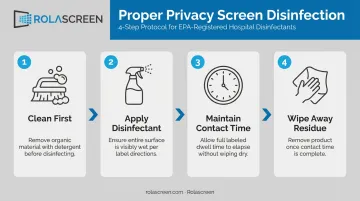
Step 1: Clean First
CDC guidance is clear: cleaning is the essential first step before disinfection. Organic matter — blood, body fluids, visible soiling — can inactivate disinfectants, particularly hypochlorites. Wipe down the surface with soap and water or a detergent solution, remove visible soil, and then apply the disinfectant.
Step 2: Apply Disinfectant Correctly
- Apply per label directions — spray onto a cloth or wipe directly if using pre-wetted wipes; avoid direct spray in patient areas where aerosolization is a concern
- Ensure the entire surface is visibly wet — patchy application leaves untreated zones
- Allow full contact time to elapse — do not wipe dry until the labeled dwell time has passed
- Wipe away residue — once contact time is complete, wipe the surface dry
Correct application only works if it's happening often enough. That's where frequency requirements come in.
Step 3: Follow the Right Frequency
CDC standards for shared noncritical equipment require cleaning and disinfection before and after each patient use. For privacy screens specifically:
- After each patient use in shared bays, ED triage, procedure rooms
- During terminal cleaning after patient discharge or transfer
- More frequently if visibly soiled or used in contact precaution settings
Fabric curtains absorb disinfectants and degrade quickly under repeated chemical exposure. Non-porous film surfaces — like the medical-grade polyester used in Rolascreen panels — withstand repeated wiping with bleach, quats, and accelerated hydrogen peroxide without surface breakdown.
Key Criteria for Choosing a Disinfectant-Compatible Privacy Screen
Before purchasing, verify these criteria against manufacturer documentation — not just product marketing:
Surface requirements:
- Non-porous, smooth, hard surface — confirmed for use with EPA-registered disinfectants per product labeling
- No textile, fabric, mesh, or perforated materials that trap pathogens or disinfectant residue
- Surfaces that maintain integrity after repeated exposure to bleach, quats, and AHP products
Hardware and frame requirements:
- Frame and hardware materials explicitly tested or rated for the disinfectant categories used in your facility
- Stainless steel or appropriately coated metals for bleach-compatible environments
- Written manufacturer documentation confirming compatibility — not verbal assurances
Documentation to request from any manufacturer:
- Written compatibility statement for sodium hypochlorite, quaternary ammonium compounds, and accelerated hydrogen peroxide
- Cross-reference against EPA List N, List K, and List H products as relevant to your patient population
- Instructions for use (IFU) that align with your facility's cleaning protocols
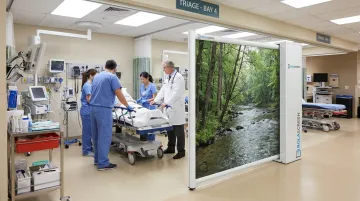
Rolascreen, manufactured in Chatsworth, California, is the only American manufacturer of retractable medical privacy screens with non-porous, wipeable inner panels rated for hospital-grade EPA-registered disinfectants, including bleach, quats, and accelerated hydrogen peroxide. With screens deployed across more than 900 hospitals, clinics, and government health facilities in 47 states (including Kaiser Permanente, UCSF, UCLA, and VA facilities), its US-based team can provide written compatibility documentation for specific disinfectant products — a step most foreign-made alternatives skip.
Contact Rolascreen at sales@rolascreen.com or 1-800-259-4214 to request compatibility documentation for your specific disinfectants.
Frequently Asked Questions
What is considered an EPA-approved disinfectant?
"EPA-registered" is the more accurate term. A product earns this status when the EPA reviews its efficacy data and confirms its label claims against specific pathogens are scientifically supported. Look for an EPA Reg. No. on the product label.
What disinfectant wipes are EPA approved?
Many wipe products carry EPA registration. Common healthcare examples include CaviWipes (Reg. No. 46781-8), Sani-Cloth AF3, Super Sani-Cloth (Reg. No. 9480-4), and Oxivir TB Wipes (Reg. No. 70627-56). Verify the EPA Reg. No. on the packaging and confirm it appears on the EPA pathogen list relevant to your setting.
Can bleach-based disinfectants damage privacy screen surfaces?
Yes. Bleach-based products can corrode or discolor bare aluminum, non-stainless metals, rubber, and some polyurethane surfaces with repeated exposure. Choose privacy screens with surfaces and hardware explicitly rated for sodium hypochlorite use, and request written documentation confirming that compatibility.
What surface materials on privacy screens are safe to use with hospital-grade disinfectants?
Non-porous, smooth, hard surfaces — such as thermally-stabilized medical-grade polyester film — are compatible with the full range of EPA-registered healthcare disinfectants, including bleach, quats, and accelerated hydrogen peroxide. Porous textiles and fabric-based screens are not, since they absorb disinfectants rather than allowing consistent surface contact and proper contact time.
How often should privacy screens in hospitals be disinfected?
Per CDC standards, shared noncritical equipment should be cleaned and disinfected before and after each patient use, and during terminal room cleaning. Screens with smooth, wipeable surfaces meet this cadence. Fabric curtains require laundering rather than wiping and cannot keep pace with high-turnover disinfection schedules.
What disinfectant is approved by the EPA for salons?
Salon and personal care settings should use EPA-registered products with bactericidal, fungicidal, and virucidal activity. For surface disinfection, EPA List N applies to SARS-CoV-2 claims, and List S covers bloodborne pathogen exposure. The same verification process applies: check the EPA Reg. No. on the label against the relevant EPA list before use.